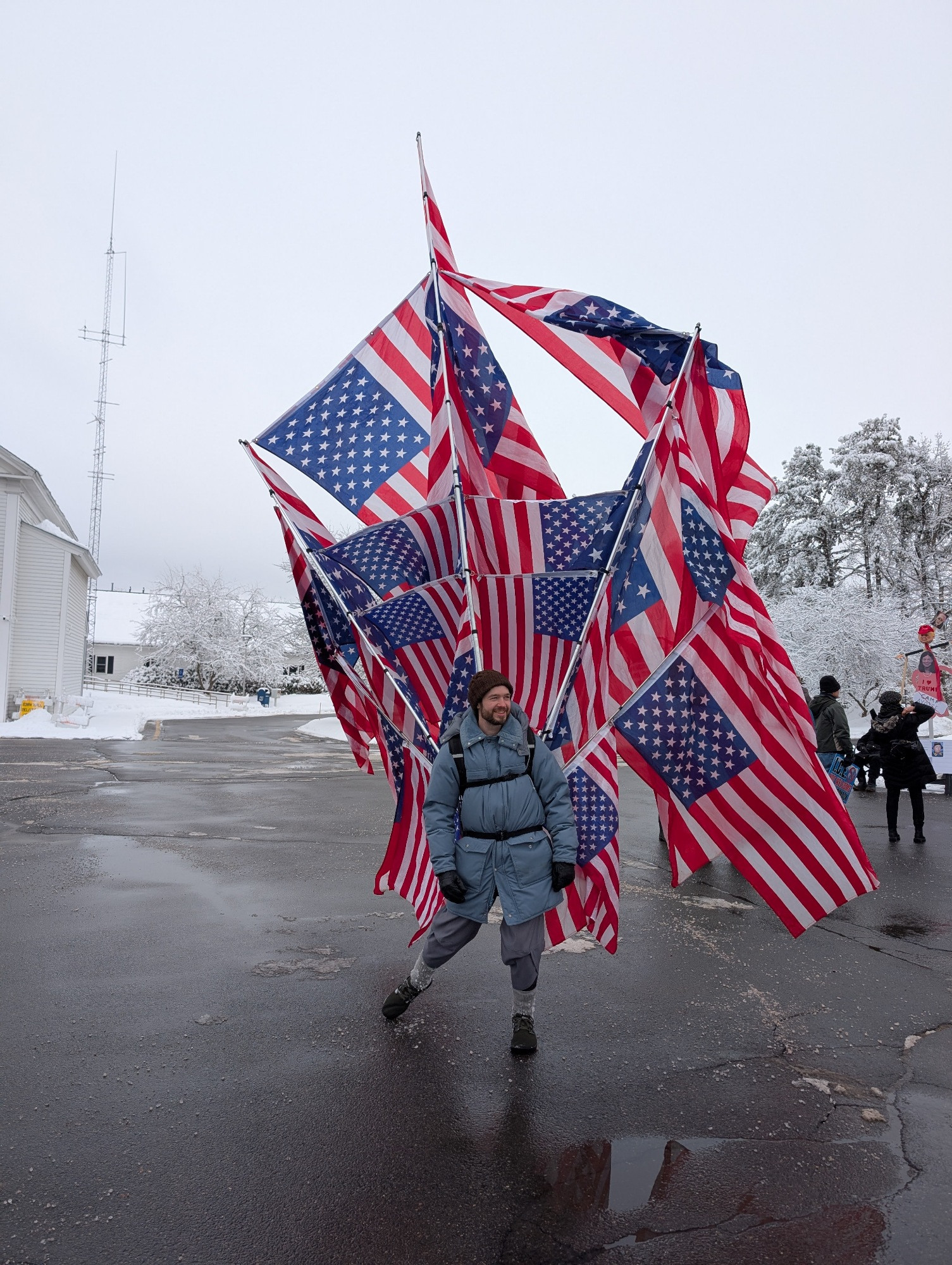
ICE wants to set up a facility in Merrimack, NH to hold its abductees. Governor Ayotte didn’t notice as ICE communicated with state officials about it, or else she’s lying. Lots of people in New Hampshire are outraged. On February 21, I went to Merrimack for the second time to attend a protest against the plan. I’m glad I did, but my reaction is mixed. The spirit I saw expressed wasn’t as good as the first time.
 There were some inspiring highlights, especially a man who stood on a huge snowbank decked out with many US flags. He looked like a human kite, and I almost worried that the wind would lift him into the air. People were there to oppose the human warehouse, which certainly would follow ICE’s usual standards for ignoring due process and treating people cruelly. Many were angry at Governor Ayotte, a modern-day Pontius Pilate who washes her hands of the whole thing.
I wore a small clip-on body camera and left my phone behind. It can’t track me, it’s inconspicuous, and it wouldn’t be as bad as losing a phone if anyone took it from me. Anyone who regularly goes to protests or observes ICE activity should consider getting one.
The crowd was big, and the atmosphere was friendly. I even ran into another member of my UU choir. At the same time, there were some aspects that made me uncomfortable.
There was a lot of chanting of obscenities. Now I’m aware that many on the left think insults and curses are the best way to win people over, but in practice it doesn’t work. When they don’t persuade people with their curses, they think their curses must not have been nasty enough. But I have to explain this, incredible as it may sound: Most people, hearing someone yell curses, don’t say, “Of course, that makes so much sense!” In fact, they’ve been known think that people who spew curses aren’t worth listening to.
There were lots of references to the facility as a “concentration camp.” It won’t be a “camp” of any kind. A concentration camp houses large numbers of people, usually based on ethnicity or culture, in barracks, makeshift buildings, or tents. In addition to the Nazis’ notorious concentration camps, examples include the British relocation of Boers during the Second Boer War and the United States’ internment of Japanese Americans during World War II. The building in Merrimack would crowd abductees to an indoor space with barely something to sleep on. The Germans’ concentration camps were a preliminary step to mass murder; others weren’t, though all were cruel to varying degrees. Let’s call a prison a prison.
The level of cursing and the widespread “concentration camp” terminology were new to me, as anti-ICE and anti-Trump protests go. We’ve heard “Alligator Auschwitz” before, which is wrong for different reasons.
Several signs treated Trump’s felony conviction as an important point. The conviction was for not treating hush money payments as campaign expenditures, which is quite minor compared to many other things he’s done. On the other hand, I didn’t see many references to his having over a hundred people killed at sea in unprovoked military attacks. They’re mass murder, and it hasn’t been stressed enough. People have even debated whether it’s OK to come back and finish off any survivors. That’s like asking whether it was legitimate for old-style pirates to make their captives walk the plank.
In times like these, though, we can’t be too picky about our allies. What’s important is that hundreds of people expressed their opposition to an inhumane government facility in New Hampshire.
 Windrip is so Trump-like you might think Lewis had a crystal ball looking into our present. He aims for total control while posturing as an ordinary, unassuming person. His platform is incoherent, laced with bigotry while appealing to the “Forgotten Man.” His Cabinet selections are based on personal loyalty. He has a personal police force, the “Minute Men,” to intimidate his critics. He even has an advisor who is smarter and more ruthless than he is.