Movies


On accompanying silent movies 2   Recently updated !

Oops — Silent Movie Day is tomorrow as I’m typing these words, there’s a blogathon coming, and I should write something! Here are some words about what I’ve learned in accompanying silent films.

The best accompanists have busy schedules, and they accompany several different movies each month if not each week, traveling a lot. I just accompany occasional movies within an easy drive from my home. But this gives me a chance to learn each movie in depth, to know every event and every surprise. This lets me get my timing as close to perfect as I can and develop thematic ideas to fit the situation. I’ve been complimented on my timing more than any other aspect of my playing.

This doesn’t mean I should punctuate every surprise and gag with a musical cue. That’s called “Mickey Mousing,” and good accompanists frown on doing too much of it. It’s OK or even necessary with physical comedy and early cartoons, but it’s the wrong approach when the story and characters are more important. Normally, the accompaniment shouldn’t call attention to itself. It should enhance the movie rather than trying to narrate it.

Sometimes the accompanist can create appropriate sound effects, using an electronic keyboard or equipment picked for the show; that’s not the same as Mickey Mousing. For D. W. Griffith’s America this summer, I provided hundreds of gunshots from my keyboard. Some accompanists bring bells or noisemakers when they fit the movie.

The ideal is for the music to feel like a part of the film. It should increase the audience’s immersion in what’s happening on the screen. Think of how a John Williams score works with a modern movie. Occasionally the music will grab your attention; storm troopers gather to the tune of the Imperial March, or a shark approaches as two alternating notes build in power. Most of the time, though, your focus is on what’s happening. The music is there, and the scene wouldn’t be nearly as effective without it, but it’s not what you’re thinking about.

Music in silent movies comes closer to the foreground, since it isn’t competing with spoken dialogue or sound effects. It’s usually continuous, while modern movies have many scenes without accompaniment. This allows more opportunities to build the film into a musical whole, but subtlety is essential.

I learn more with each movie I accompany. Here’s a list of what I’ve accompanied and what I’m scheduled to accompany.

Note: I’ve changed the blogathon links in this post to point at the more complete list on The Everyday Cinephile. You need to scroll down a little to see the list of participating posts.
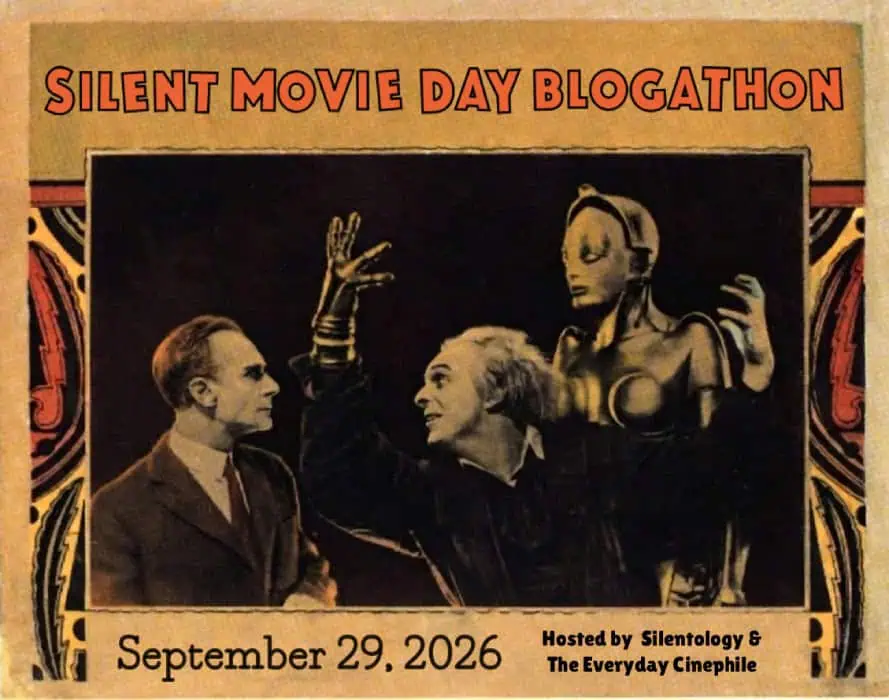
Scene from the silent film Metropolis with text: Silent Movie Day Blogathon / September 29, 2026


SUBSCRIBE

Enter your email address to subscribe and get notifications of new posts by email.


Silent (and not quite silent) film plans 2

The showing of the 1924 film America with my accompaniment went well. You can catch it on YouTube. To be exact, it’s the audio from the Plaistow Library together with video copied from the Internet Archive, the same video that was shown at the library.

My next planned show in Plaistow will be the traditional Halloween horror movie, this time the 1931 Frankenstein, with Colin Clive in the title role and Boris Karloff as the monster. Yes, I know, it’s not a silent movie. But it has little music, and some silent film accompanists have added badly-needed music to it. That’s what I’ll be doing. It’s LIVE!!


Upcoming silent film: D. W. Griffith’s America

On June 23, I’ll be back at the Plaistow Library to accompany the silent film America, made by D. W. Griffith. It will start at 6 PM and run about 2 hours and 20 minutes. Reservations are encouraged so the library knows how many people to expect.

The show is part of the events observing the 250th anniversary of the Declaration of Independence. There will also be a presentation on the Battle of Bunker Hill on June 9, held by the Plaistow Historical Society. As I’m writing, not much information is available on it, but it should be interesting.

Griffith is famous (or infamous) for his 1915 film Birth of a Nation, which presents the Civil War and glorifies the KKK. America, released in 1924, is about the American Revolution. Both films have spectacular battle scenes and stories focusing on individuals. Both have a mix of accurate history and made-up stuff. America culminates in a made-up battle at a made-up place, but the early parts of the Revolution (Lexington, Concord, and Bunker Hill) are presented fairly accurately. The film doesn’t have the same level of racial problems as the earlier film. There is a black servant, but he isn’t mocked or caricatured (though I’m pretty sure a while actor played him). Natives who fight for the British are called “savages.” Things like that happen in century-old movies.

Poster for the film "America" (1924)The chief villain is a Tory rather than anyone from Britain. Lionel Barrymore portrays Walter Butler, a real-life Loyalist officer, as a sadistic schemer with an evil grin, which he wasn’t in reality. The British regulars are generally shown as brave soldiers. I wonder if Griffith remembered that the maker of the 1917 Spirit of ’76 got a long prison sentence for making an “anti-British” movie when Britain was our ally in World War I. It may have seemed safer to show Tories doing nasty things. Even as it was, the British Board of Film Censors banned the film.

The story of the war is intertwined with a love story; a Patriot is in love with the daughter of a man who remains loyal to Britain. Both of them prove honorable in the end.

As usual, I’ll provide original, live music for the film.


Three silent shorts, April 7

My next silent film show at the Plaistow Library will be on Tuesday, April 7. This time I’ll accompany three short comedies:

  • The Immigrant with Charlie Chaplin
  • Dr. Pyckle and Mr. Pryde with Stan Laurel
  • His Royal Slyness with Harold Lloyd

Chaplin, Laurel, and Lloyd were major comedy stars in their time. I shouldn’t have to say much about Chaplin. Stan Laurel’s career peaked after he joined with Oliver Hardy, but before that he had some excellent films on his own. Harold Lloyd’s “glasses” persona was a middle-class character, best known for his image hanging from a clock tower in Safety Last.

The Immigrant isn’t very controversial, in spite of its title. It has two distinct parts. The first shows Chaplin coming to America on a crowded boat from an unspecified country and helping a young woman whose money has been stolen. In the second part, he goes into a restaurant with a silver dollar he has found and encounters the young lady again. He discovers that the coin has fallen through a hole in his pocket and he has nothing to pay with. All turns out well, though.

I love mad scientists, Dr. Pyckle and Mr. Pryde is a great parody of John Barrymore’s 1920 Dr. Jekyll and Mr. Hyde. In this version, the doctor turns into not a murderous fiend but a silly prankster. The ending is lost, and what we have ends on a cliffhanger as a crowd breaks into the lab to save Pyckle’s assistant from Pryde. I’ll handle it by continuing to play, accompanying the way I think the film would have ended.

Finally, His Royal Slyness has a book salesman, played by Harold Lloyd, impersonate a prince and compete for a princess’s hand. The salesman looks just like the real prince, and you see them together on screen. No trick photography was used. Harold’s brother Gaylord looked a lot like him, and with glasses and makeup, they were nearly impossible to tell apart. Gaylord plays the real prince, who changes his mind about the deal and tries to claim the princess.

It’s a change of pace for me. The three movies together don’t run much over an hour, but they provide some of the best laughs of the period. They’re still fun today, and I aim to make them more fun with my accompaniment. Each one his its own keyboard setup, with a couple of surprises programmed in. If you’re in the area and it sounds interesting, drop by the Plaistow Library on April 7 at 6:00 PM.

This summer, the library will have some special events for the 250th anniversary of the Declaration of Independence. On of them will be D. W. Griffith’s America, an epic presentation of the American Revolution. The date hasn’t been set yet.


Gugusse et l’Automate: Rediscovery of the first robot film

If you’ve seen the movie Hugo (and you should), you remember the wonderful scene where a humanoid automaton is restored and goes into action, revealing an important secret. Georges Méliès found these machines fascinating. His 1897 Gugusse et l’Automate presents an automaton (played by an actor) in what has been called the world’s first film about a robot. Bill McFarland brought a box of old films from Grand Rapids, Michigan to the National Audio-Visual Conservation Center in Virginia, and one of them was a third-generation copy of Gugusse. Film historians had known it existed, but no one now living had seen it. The preservation experts digitized the one-minute film, which I’m sure must have been fragile, and it’s now available freely on YouTube and other sites.

Here’s a link to the video on the LOC site. I’ve edited this post to link rather than embed, since the embed wasn’t always working.