New Hampshire


Sloppy rhetoric kills credibility 5

The ACLU of New Hampshire has taken a position against New Hampshire SB 434, which it characterizes as “a bill to create avenues to ban books in New Hampshire.” As the word “ban” is normally understood in the legal sense, it means to categorically prohibit. A banned book is one that it’s illegal to own or distribute. The bill may be a bad one, but that’s not what it would do.
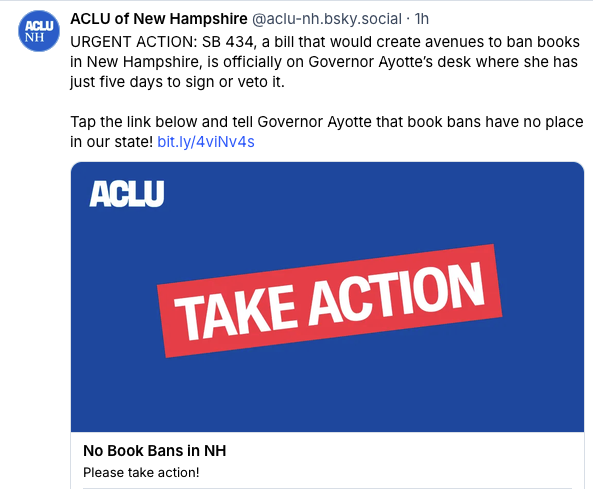
Bluesky screenshot from ACLU of New Hampshire

Governor Ayotte has vetoed the bill, so the issue is effectively dead for now. An override is possible but unlikely. What I’m writing about here is how the NH ACLU framed the issue.

The bill would have created a mechanism by which parents or guardians can challenge a book that’s available in a public school as “obscene and harmful to minors.” Successfully challenged books would not be “banned in New Hampshire”; anyone could still get them through the usual markets. Arguably it makes it too easy to challenge books based on little or no knowledge of their content, but schools already can and do exclude books. In most cases, it’s just that they can’t get every book that’s in print, but sometimes it’s because the books are badly written garbage. If intentionally excluding a book is “banning,” then every school already “bans” books.

There’s legitimate concern that making challenges easier would lead to the exclusion of books that have real value. But the point is not that schools should indiscriminately carry any and all books, or that any policy that excludes some books “bans” them.

In her veto statement, Ayotte correctly framed the issue as one of policy: “As a parent, I understand and appreciate the concerns parents have about their children being exposed to age-inappropriate or objectionable materials in schools. At the same time, existing New Hampshire law already requires school districts to adopt a policy allowing an exception to specific course material based on a parent’s determination that the material is objectionable.”

In its call for action, the NH ACLU claimed, “The right to free expression includes the freedom to read whatever we choose. Yet our state government is attempting to make it easier to ban books right here in New Hampshire.” You have the right to read whatever you choose, but not the right to get it for free. It isn’t “banning” to say you have to pay for something out of your own pocket.

How schools select books is an important issue. A challenge procedure that encourages moral panics could be very bad, pushing schools into carrying only the safest books. But it’s a policy issue, not a rights issue. The real threats to free expression are growing: intimidation and even arrests of people who criticize officials, groundless lawsuits against news sources backed by threats of executive action, proposals for Internet censorship. If people who are already skeptical see library policies called “book bans,” they won’t pay as much attention to the real dangers to liberty.

There has been real book banning in the United States. The Comstock Act criminalized mailing “obscene” material, such as information on birth control. It’s never been repealed, though court rulings have greatly narrowed it. The owners of a bookstore in San Francisco were arrested and prosecuted for carrying Howl and Other Poems by Allan Ginsberg, eventually winning a landmark case. Such prosecution is rare today, but it could come back.

It’s especially bad when a chapter of the ACLU trivializes the concept. When individuals, even well-known ones, abuse the language, it mostly reflects on them personally. When a civil liberties organization does it, it damages the cause of civil liberties.


Silent (and not quite silent) film plans 2

The showing of the 1924 film America with my accompaniment went well. You can catch it on YouTube. To be exact, it’s the audio from the Plaistow Library together with video copied from the Internet Archive, the same video that was shown at the library.

My next planned show in Plaistow will be the traditional Halloween horror movie, this time the 1931 Frankenstein, with Colin Clive in the title role and Boris Karloff as the monster. Yes, I know, it’s not a silent movie. But it has little music, and some silent film accompanists have added badly-needed music to it. That’s what I’ll be doing. It’s LIVE!!


June 21 is not New Hampshire’s birthday

On June 21, 1788, New Hampshire ratified the United States Constitution. As the ninth state to ratify, it made the Constitution go into effect. This is an important anniversary. However, some idiots claim that makes it New Hampshire’s “birthday.” They seem to think that rather than the state of New Hampshire letting the Constitution take effect, the Constitution brought New Hampshire into existence.

That erases a huge amount of history. The first settlements were established along the coast and Great Bay starting in 1623. In 1635, King Charles I issued a grant of the “Province of New Hampshire.” For a while Massachusetts claimed what is now southeastern New Hampshire. Things went back and forth until William and Mary declared New Hampshire a royal colony in 1691. It was the first state to draw up its own constitution, six months before the Declaration of Independence. The Declaration lists it as one of the “free and independent states.” It was one of the parties to the Articles of Confederation.

You can choose New Hampshire’s “birthday” from several historical events. I like April 18, the date of the provincial grant. By any measure, New Hampshire existed long before the U. S. Constitution.


Note on the LPNH

Just a quick note to say that the Libertarian Party of New Hampshire is a misnamed organization that I definitely don’t support. I call myself a libertarian or classical liberal, I live in New Hampshire, and I used to be involved with the LPNH when it was a much better organization. It got taken over by some people who don’t comprehend or don’t care about libertarian principles.

It’s been in the news because the national LP has revoked the state party’s affiliation. Carla Gericke, one of the founders of the Free State Project, described the state organization’s actions as “self-destructive, counterproductive, and increasingly unhinged.”

Several years ago, I was involved with LPNH Seacoast, a regional affiliate of LPNH. It has good people, with an emphasis on supporting everyone’s rights. It slipped away, and I lost contact with the people involved.

It would be nice if someone would start a new organization in the state. There are a lot of good libertarians and classical liberals in the state who are now homeless. I lack the skills to make it happen. Someone must have them.


Unveiling the Ona Judge Mural

On Saturday, May 23, I went to Portsmouth to see the unveiling of the mural of Ona Judge. The crowd was huge, spilling over onto Court Street so the police had to close the street for a block. I’d say a couple of hundred. Various speakers had their say. Some were politicians who showed up to look important, others were actually involved with the project, and one was the artist. Unfortunately, I couldn’t hear any of them very well from where I was.

The main point of this post is to let you see the pictures, so I’ll leave it at that.

Ona Judge mural with crowd around it