Sloppy rhetoric kills credibility 5
The ACLU of New Hampshire has taken a position against New Hampshire SB 434, which it characterizes as “a bill to create avenues to ban books in New Hampshire.” As the word “ban” is normally understood in the legal sense, it means to categorically prohibit. A banned book is one that it’s illegal to own or distribute. The bill may be a bad one, but that’s not what it would do.
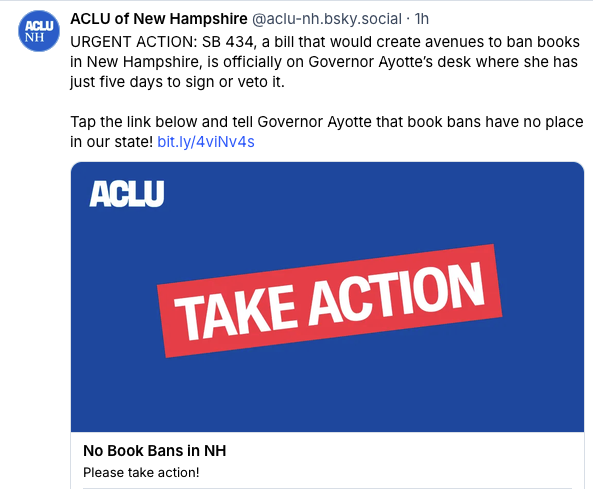
Governor Ayotte has vetoed the bill, so the issue is effectively dead for now. An override is possible but unlikely. What I’m writing about here is how the NH ACLU framed the issue.
The bill would have created a mechanism by which parents or guardians can challenge a book that’s available in a public school as “obscene and harmful to minors.” Successfully challenged books would not be “banned in New Hampshire”; anyone could still get them through the usual markets. Arguably it makes it too easy to challenge books based on little or no knowledge of their content, but schools already can and do exclude books. In most cases, it’s just that they can’t get every book that’s in print, but sometimes it’s because the books are badly written garbage. If intentionally excluding a book is “banning,” then every school already “bans” books.
There’s legitimate concern that making challenges easier would lead to the exclusion of books that have real value. But the point is not that schools should indiscriminately carry any and all books, or that any policy that excludes some books “bans” them.
In her veto statement, Ayotte correctly framed the issue as one of policy: “As a parent, I understand and appreciate the concerns parents have about their children being exposed to age-inappropriate or objectionable materials in schools. At the same time, existing New Hampshire law already requires school districts to adopt a policy allowing an exception to specific course material based on a parent’s determination that the material is objectionable.”
In its call for action, the NH ACLU claimed, “The right to free expression includes the freedom to read whatever we choose. Yet our state government is attempting to make it easier to ban books right here in New Hampshire.” You have the right to read whatever you choose, but not the right to get it for free. It isn’t “banning” to say you have to pay for something out of your own pocket.
How schools select books is an important issue. A challenge procedure that encourages moral panics could be very bad, pushing schools into carrying only the safest books. But it’s a policy issue, not a rights issue. The real threats to free expression are growing: intimidation and even arrests of people who criticize officials, groundless lawsuits against news sources backed by threats of executive action, proposals for Internet censorship. If people who are already skeptical see library policies called “book bans,” they won’t pay as much attention to the real dangers to liberty.
There has been real book banning in the United States. The Comstock Act criminalized mailing “obscene” material, such as information on birth control. It’s never been repealed, though court rulings have greatly narrowed it. The owners of a bookstore in San Francisco were arrested and prosecuted for carrying Howl and Other Poems by Allan Ginsberg, eventually winning a landmark case. Such prosecution is rare today, but it could come back.
It’s especially bad when a chapter of the ACLU trivializes the concept. When individuals, even well-known ones, abuse the language, it mostly reflects on them personally. When a civil liberties organization does it, it damages the cause of civil liberties.