Censorship


Sloppy rhetoric kills credibility 5

The ACLU of New Hampshire has taken a position against New Hampshire SB 434, which it characterizes as “a bill to create avenues to ban books in New Hampshire.” As the word “ban” is normally understood in the legal sense, it means to categorically prohibit. A banned book is one that it’s illegal to own or distribute. The bill may be a bad one, but that’s not what it would do.
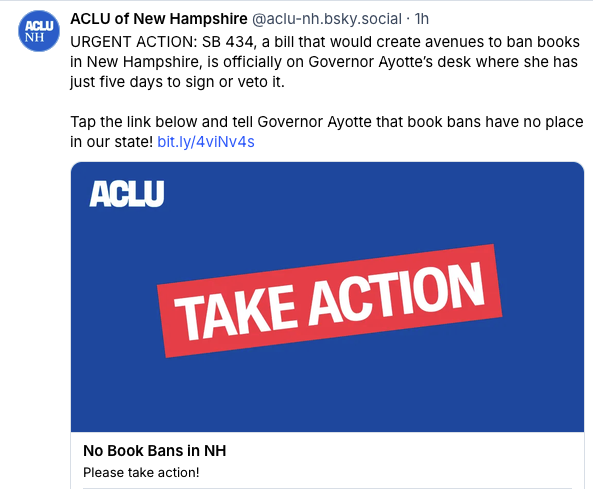
Bluesky screenshot from ACLU of New Hampshire

Governor Ayotte has vetoed the bill, so the issue is effectively dead for now. An override is possible but unlikely. What I’m writing about here is how the NH ACLU framed the issue.

The bill would have created a mechanism by which parents or guardians can challenge a book that’s available in a public school as “obscene and harmful to minors.” Successfully challenged books would not be “banned in New Hampshire”; anyone could still get them through the usual markets. Arguably it makes it too easy to challenge books based on little or no knowledge of their content, but schools already can and do exclude books. In most cases, it’s just that they can’t get every book that’s in print, but sometimes it’s because the books are badly written garbage. If intentionally excluding a book is “banning,” then every school already “bans” books.

There’s legitimate concern that making challenges easier would lead to the exclusion of books that have real value. But the point is not that schools should indiscriminately carry any and all books, or that any policy that excludes some books “bans” them.

In her veto statement, Ayotte correctly framed the issue as one of policy: “As a parent, I understand and appreciate the concerns parents have about their children being exposed to age-inappropriate or objectionable materials in schools. At the same time, existing New Hampshire law already requires school districts to adopt a policy allowing an exception to specific course material based on a parent’s determination that the material is objectionable.”

In its call for action, the NH ACLU claimed, “The right to free expression includes the freedom to read whatever we choose. Yet our state government is attempting to make it easier to ban books right here in New Hampshire.” You have the right to read whatever you choose, but not the right to get it for free. It isn’t “banning” to say you have to pay for something out of your own pocket.

How schools select books is an important issue. A challenge procedure that encourages moral panics could be very bad, pushing schools into carrying only the safest books. But it’s a policy issue, not a rights issue. The real threats to free expression are growing: intimidation and even arrests of people who criticize officials, groundless lawsuits against news sources backed by threats of executive action, proposals for Internet censorship. If people who are already skeptical see library policies called “book bans,” they won’t pay as much attention to the real dangers to liberty.

There has been real book banning in the United States. The Comstock Act criminalized mailing “obscene” material, such as information on birth control. It’s never been repealed, though court rulings have greatly narrowed it. The owners of a bookstore in San Francisco were arrested and prosecuted for carrying Howl and Other Poems by Allan Ginsberg, eventually winning a landmark case. Such prosecution is rare today, but it could come back.

It’s especially bad when a chapter of the ACLU trivializes the concept. When individuals, even well-known ones, abuse the language, it mostly reflects on them personally. When a civil liberties organization does it, it damages the cause of civil liberties.

Quebec’s prayer ban

With Worldcon coming up in Montreal next year, fans who go there will have to be aware of Quebec’s anti-prayer law. It imposes serious restrictions on religious freedom. Group prayer in public requires government permission. People have had to choose between wearing religious symbols and quitting their jobs. The Canadian Civil Liberties Association (CCLA) has condemned the law as an “attack on freedom of religion, freedom of expression, protest rights, and equality.”

The law is touted as promoting religious neutrality, but it’s no more neutral than a ban on all protests is.

The law has been challenged in Canada’s Supreme Court, so it might not be an issue when the convention comes around.

Some of its provisions will affect just people living and working in the province. I’ll focus here on the impact on visitors.

Scene from Faust, Mephistopheles commanding Marguerite not to prayA lot depends on the word “public.” What is a “public place”? The streets of Montreal are certainly public, but what about the Palais de Congrès, where the convention will take place? What about hotels where fans will stay? Will the convention be able to schedule religious gatherings? This is a question for lawyers, and I hope the con will have some answers for the public. I wrote to the convention’s address for asking questions, and so far I’ve gotten an acknowledgement but no other response. Probably they’re still working on it.

In practice, there’s a good chance only Muslims will be targeted for enforcement. As an atheist, I’m not directly affected by a prayer ban, but laws denying freedom of expression undermine the principle and have a chilling effect on all discourse. In 2025, Montreal slapped a church with a $2,500 fine for hosting a concert by a singer the government didn’t like. I think Sean Feucht is all wet (bonus pun for German speakers!), but that’s not the point. If the city can fine private organizations for hosting singers or speakers based on the ideas they support, it can silence anyone, and events such as fan conventions aren’t safe.


Gagging social media in Methuen 4

The city of Methuen, Massachusetts, has adopted a resolution to restrict access to social media on city-owned devices. The announcement states that “City-owned devices and networks in City buildings and City-run youth programs will limit access to social media for minors under 16 whenever feasible.” This would clearly apply to Methuen’s Nevins Library, which provides computers for public use.

The statement has the tone of fanaticism that’s gone so far over the edge that it doesn’t even require yelling; of course every reasonable person will agree with it, won’t you? It’s FOR THE CHILDREN! The council favorably cites Australia’s total ban on use of social media by anyone under 16. The statement expresses hope for nationwide restrictions: “The Council also formally endorsed Mayor Beauregard’s commitment to advocate for state and federal policies that restrict social media access for children under 16 and strengthen youth digital safety protections nationwide.”

It’s the familiar idea that libraries should reject or restrict access to anything deemed “harmful to minors,” where “harmful” has a very broad definition. It’s the same mindset that demands they keep all books on certain topics away from kids’ eyes.

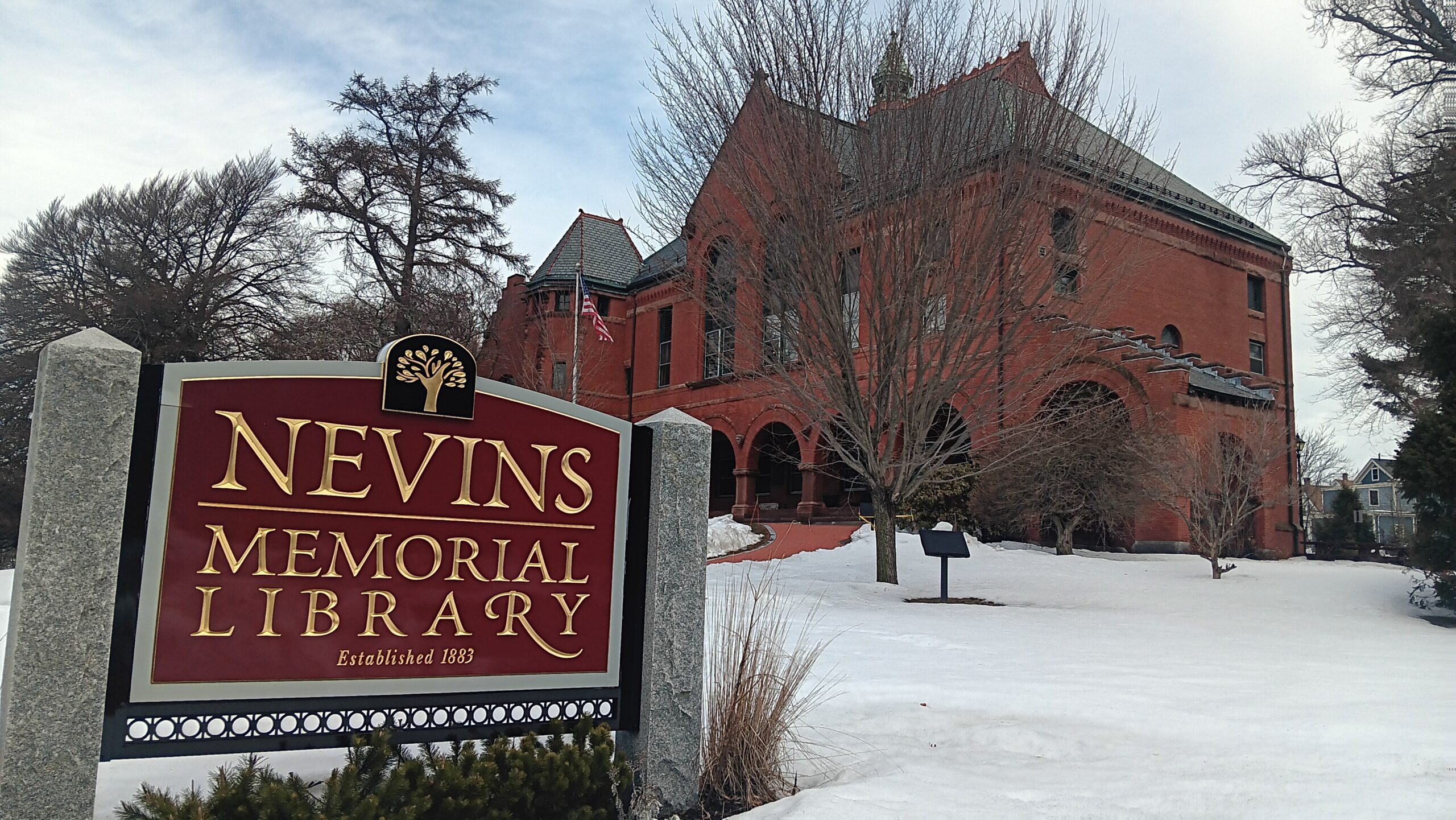
Nevins Memorial Library, Methuen, Mass.On Saturday I went to tne Nevins Library to find out how it’s going to be affected. The people working there said they hadn’t received any direct communication, even though the impact will fall most heavily on them. They don’t know what’s going to be expected of them.

The term “social media” can encompass any Internet service that enables public conversation. Restrictions on using social media are restrictions on discussion. Sometimes these discussions are vitally important to young people, especially if they’re dealing with domestic abuse or have issues they’re afraid to raise with their parents. They can help to get information for personal or educational reasons, and often people make friends from distant places and different cultures.

A lot of basic information is found on social media. YouTube is generally considered a social media site; anyone can upload videos, and most of them are open for comments. Many businesses use their Facebook page as their main Internet presence. Telling kids they can’t use these sites or subjecting them to heavy restrictions will cut them off from a lot of information.

The present situation is reminiscent of panics in which kids had to be “protected” from novels, comic books, rock’n’roll, TV, and video games. Who will protect us from the protectors?


Bad news for free speech in Bow, NH

This has been a bad year for freedom of expression in the United States. ICE thugs have hauled people away without charges for expressing views that the government doesn’t like. In New Hampshire, a federal judge has delivered an outrageous decision regarding a protest in Bow, New Hampshire.

The ruling by Judge Steven McAuliffe is full of absurdities and disregard for the First Amendment. The basic argument is that school athletic events are a limited public forum, and the schools retain some control over types of expression at them. This is true, but it doesn’t mean they can arbitrarily decide what people can say or can’t. The restrictions have to serve a legitimate purpose and be viewpoint-neutral, and they have to be enforced evenly.
(more…)


ICE: America’s Gestapo

“Geheime Staatspolizei” means “secret state police,” usually shortened to “Gestapo.” It was the Nazis’ enforcement bureau, the ones who snatched people without charges and sent them away to prisons or execution. In the United States, it’s shortened to “ICE.” Its masked thugs have snatched people off the street, not presenting any criminal charges, and shipped them to offshore hellholes. So far I haven’t heard of its intentionally killing anyone, though people have died in its custody.
(more…)