silent movies


Silent film update for January 2027   Recently updated !

I’m accompanying two silent films in January. On the 16th, at 1:00 PM, I’ll provide accompaniment for the early Frank Capra film, Power of the Press, at the Museum of Printing in Haverhill, Mass. The movie stars a young Douglas Fairbanks, Jr. Printing historian Frank Romano will provide background information on newspapers of the period. There’s an admission charge for visiting the museum.

On Tuesday, January 19, at 6 PM, I’ll accompany a silent movie, title yet to be determined, at the Plaistow (NH) Library. Free admission and popcorn, as usual. Update: The film will be Toll of the Sea, in Technicolor, with Anna May Wong in her first starring role.

In the meantime, Frankenstein is coming up at the Plaistow Library on November 10: the 1910 Edison short with my accompaniment, and the 1931 classic with additional music from me.


Thoughts on Frankenstein (1931) 1

This fall, I’ll provide musical accompaniment to the 1931 Frankenstein in two New Hampshire libraries: Rye on October 30 and Plaistow on November 10. The movie has spoken dialogue, but it doesn’t have much music. Many of its scenes work better when accompanied, and several silent film accompanists have shown the film with their music. I’ll be doing the same at these showings. The showing in Plaistow will have Edison’s silent 1910 Frankenstein as an introductory short.

I’ve watched the movie several times in preparation, and it’s impressive, especially the first half. Boris Karloff did a fantastic acting job under heavy makeup and with no lines.
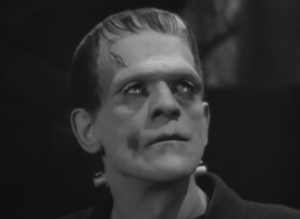
Boris Karloff in Frankenstein (1931) looking upwardThe story, adapted from a stage play, is very different from Shelley’s. There’s next to nothing left of the examination of the creator’s responsibility and the creature’s frustrated efforts to deal with the world. The first names of Victor Frankenstein and his friend Henry Clerval are swapped. (Isn’t Victor a perfectly good name for a mad scientist?) On its own terms, though, it’s a good story.

The first half is by far the better part. In the creature’s first appearance, he’s ugly but sympathetic. The sequence where he sees sunlight for the first time and reaches upward for it is iconic. When the light is closed off, he pleads with his hands. For what, we’re left to guess. This was first-rate acting by Karloff.

He never attacks anyone unless he feels threatened. His killings of Fritz and Dr. Waldman are self-defense. He unintentionally drowns a little girl while trying to play with her, because he has no experience of what humans can withstand.

After that, things go off the rails. The girl’s father says she’s been murdered, but how does he know? All he knows is that she drowned in the pond. Then the creature enters Frankenstein’s house on his wedding day and menaces Elizabeth. When he hears others coming, he runs off. The scene fails to make sense. Did he somehow know it was Frankenstein’s house, or did he wander in by chance? Why did he threaten Elizabeth? He’d never seen her before. It’s a bad adaptation of what happened in the book: the creature (who can speak) carries out his threat to take revenge on Frankenstein’s wedding night, killing Elizabeth.

A crowd with torches assembles to hunt the creature, Frankenstein leading one of the groups. He tracks his creature to a windmill. The creature knocks him out and, for some reason, carries him into the mill. This scene did permanent damage to Karloff’s back. The mill catches fire from the torches, Frankenstein falls out and survives, and the terrified creature he realizes he’s going to burn to death and no one will help him.

This is the stuff of tragedy. The creature faces only hostility, and the one time he makes a friend, it goes horribly wrong. He dies abandoned.

I’m working on another silent film project in a new venue. Watch for information when I have something to announce.

On accompanying silent movies 2

Oops — Silent Movie Day is tomorrow as I’m typing these words, there’s a blogathon coming, and I should write something! Here are some words about what I’ve learned in accompanying silent films.

The best accompanists have busy schedules, and they accompany several different movies each month if not each week, traveling a lot. I just accompany occasional movies within an easy drive from my home. But this gives me a chance to learn each movie in depth, to know every event and every surprise. This lets me get my timing as close to perfect as I can and develop thematic ideas to fit the situation. I’ve been complimented on my timing more than any other aspect of my playing.

This doesn’t mean I should punctuate every surprise and gag with a musical cue. That’s called “Mickey Mousing,” and good accompanists frown on doing too much of it. It’s OK or even necessary with physical comedy and early cartoons, but it’s the wrong approach when the story and characters are more important. Normally, the accompaniment shouldn’t call attention to itself. It should enhance the movie rather than trying to narrate it.

Sometimes the accompanist can create appropriate sound effects, using an electronic keyboard or equipment picked for the show; that’s not the same as Mickey Mousing. For D. W. Griffith’s America this summer, I provided hundreds of gunshots from my keyboard. Some accompanists bring bells or noisemakers when they fit the movie.

The ideal is for the music to feel like a part of the film. It should increase the audience’s immersion in what’s happening on the screen. Think of how a John Williams score works with a modern movie. Occasionally the music will grab your attention; storm troopers gather to the tune of the Imperial March, or a shark approaches as two alternating notes build in power. Most of the time, though, your focus is on what’s happening. The music is there, and the scene wouldn’t be nearly as effective without it, but it’s not what you’re thinking about.

Music in silent movies comes closer to the foreground, since it isn’t competing with spoken dialogue or sound effects. It’s usually continuous, while modern movies have many scenes without accompaniment. This allows more opportunities to build the film into a musical whole, but subtlety is essential.

I learn more with each movie I accompany. Here’s a list of what I’ve accompanied and what I’m scheduled to accompany.

Note: I’ve changed the blogathon links in this post to point at the more complete list on The Everyday Cinephile. You need to scroll down a little to see the list of participating posts.

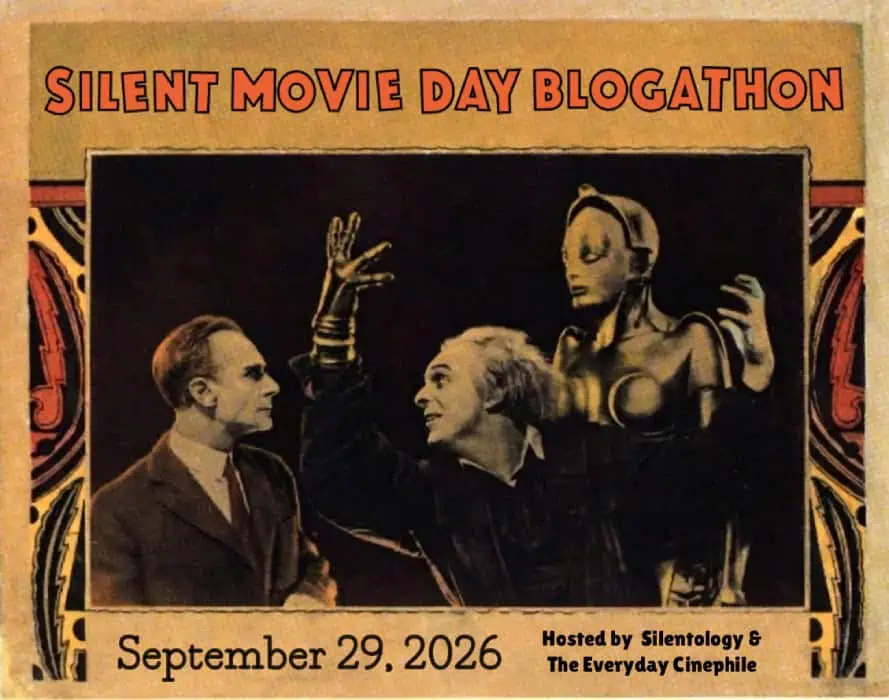
Scene from the silent film Metropolis with text: Silent Movie Day Blogathon / September 29, 2026


SUBSCRIBE

Enter your email address to subscribe and get notifications of new posts by email.


Silent (and not quite silent) film plans 2

The showing of the 1924 film America with my accompaniment went well. You can catch it on YouTube. To be exact, it’s the audio from the Plaistow Library together with video copied from the Internet Archive, the same video that was shown at the library.

My next planned show in Plaistow will be the traditional Halloween horror movie, this time the 1931 Frankenstein, with Colin Clive in the title role and Boris Karloff as the monster. Yes, I know, it’s not a silent movie. But it has little music, and some silent film accompanists have added badly-needed music to it. That’s what I’ll be doing. It’s LIVE!!


Upcoming silent film: D. W. Griffith’s America

On June 23, I’ll be back at the Plaistow Library to accompany the silent film America, made by D. W. Griffith. It will start at 6 PM and run about 2 hours and 20 minutes. Reservations are encouraged so the library knows how many people to expect.

The show is part of the events observing the 250th anniversary of the Declaration of Independence. There will also be a presentation on the Battle of Bunker Hill on June 9, held by the Plaistow Historical Society. As I’m writing, not much information is available on it, but it should be interesting.

Griffith is famous (or infamous) for his 1915 film Birth of a Nation, which presents the Civil War and glorifies the KKK. America, released in 1924, is about the American Revolution. Both films have spectacular battle scenes and stories focusing on individuals. Both have a mix of accurate history and made-up stuff. America culminates in a made-up battle at a made-up place, but the early parts of the Revolution (Lexington, Concord, and Bunker Hill) are presented fairly accurately. The film doesn’t have the same level of racial problems as the earlier film. There is a black servant, but he isn’t mocked or caricatured (though I’m pretty sure a while actor played him). Natives who fight for the British are called “savages.” Things like that happen in century-old movies.

Poster for the film "America" (1924)The chief villain is a Tory rather than anyone from Britain. Lionel Barrymore portrays Walter Butler, a real-life Loyalist officer, as a sadistic schemer with an evil grin, which he wasn’t in reality. The British regulars are generally shown as brave soldiers. I wonder if Griffith remembered that the maker of the 1917 Spirit of ’76 got a long prison sentence for making an “anti-British” movie when Britain was our ally in World War I. It may have seemed safer to show Tories doing nasty things. Even as it was, the British Board of Film Censors banned the film.

The story of the war is intertwined with a love story; a Patriot is in love with the daughter of a man who remains loyal to Britain. Both of them prove honorable in the end.

As usual, I’ll provide original, live music for the film.