Thoughts on Frankenstein (1931) Recently updated !
This fall, I’ll provide musical accompaniment to the 1931 Frankenstein in two New Hampshire libraries: Rye on October 30 and Plaistow on November 10. The movie has spoken dialogue, but it doesn’t have much music. Many of its scenes work better when accompanied, and several silent film accompanists have shown the film with their music. I’ll be doing the same at these showings. The showing in Plaistow will have Edison’s silent 1910 Frankenstein as an introductory short.
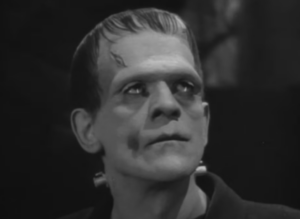
I’ve watched the movie several times in preparation, and it’s impressive, especially the first half. Boris Karloff did a fantastic acting job under heavy makeup and with no lines.
 The story, adapted from a stage play, is very different from Shelley’s. There’s next to nothing left of the examination of the creator’s responsibility and the creature’s frustrated efforts to deal with the world. The first names of Victor Frankenstein and his friend Henry Clerval are swapped. (Isn’t Victor a perfectly good name for a mad scientist?) On its own terms, though, it’s a good story.
The first half is by far the better part. In the creature’s first appearance, he’s ugly but sympathetic. The sequence where he sees sunlight for the first time and reaches upward for it is iconic. When the light is closed off, he pleads with his hands. For what, we’re left to guess. This was first-rate acting by Karloff.
He never attacks anyone unless he feels threatened. His killings of Fritz and Dr. Waldman are self-defense. He unintentionally drowns a little girl while trying to play with her, because he has no experience of what humans can withstand.
After that, things go off the rails. The girl’s father says she’s been murdered, but how does he know? All he knows is that she drowned in the pond. Then the creature enters Frankenstein’s house on his wedding day and menaces Elizabeth. When he hears others coming, he runs off. The scene fails to make sense. Did he somehow know it was Frankenstein’s house, or did he wander in by chance? Why did he threaten Elizabeth? He’d never seen her before. It’s a bad adaptation of what happened in the book: the creature (who can speak) carries out his threat to take revenge on Frankenstein’s wedding night, killing Elizabeth.
A crowd with torches assembles to hunt the creature, Frankenstein leading one of the groups. He tracks his creature to a windmill. The creature knocks him out and, for some reason, carries him into the mill. This scene did permanent damage to Karloff’s back. The mill catches fire from the torches, Frankenstein falls out and survives, and the terrified creature he realizes he’s going to burn to death and no one will help him.
This is the stuff of tragedy. The creature faces only hostility, and the one time he makes a friend, it goes horribly wrong. He dies abandoned.
I’m working on another silent film project in a new venue. Watch for information when I have something to announce.