Monthly Archives: February 2026


Book discussion: You Don’t Own Me   Recently updated !

I’ve been neglecting book discussion posts. Starting with this one, I want to make them a more regular feature of this blog, at least one a month. Books are important, and doing this will not only help me to get the word out about them, it will push me to read more.

(I thought I’d published this a month ago, but I can’t find it in my blog. Here it is now. My next book discussion should follow very soon.)

Individualism isn’t just a political concept. It’s an outlook on life, the recognition that each person is distinct and important. An outlook that values the individual affects our personal interactions. The arts can affirm this outlook or reject it. Timothy Sandefur’s You Don’t Own Me addresses the intersection of the arts and individualism, with mixed results.

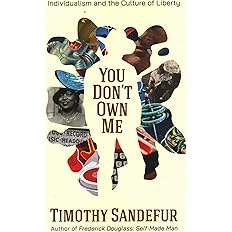
Cover of You Don't Own Me by Timothy SandefurThe cover art looks like jigsaw pieces that don’t obviously fit together, which could also describe the book. It’s a series of loosely connected essays. The second one is the text of a speech, which with a little editing would have fitted better into the book. Some of the sections are quite good. “Zora Neale Hurston, Undefeated” makes me want to learn more about that author. On the other hand, “Anarchy, State, and Zombie Dystopia,” a discussion of The Walking Dead, left me confused because he assumes the reader is already familiar with it. Someone not as obsessively familiar as me with Star Trek might say the same of “Navigating by Fixed Stars: The Moral Trajectory of Star Trek.”
Fragmented as it is, the book will still introduce readers to authors and musicians who have upheld individualist values. It may also give them new information about familiar creators. For instance, I hadn’t known that the time from William Sydney Porter’s first published story as “O. Henry” to his death was barely more than a decade. In at least one case I wish he’d given more information; he credits the song “You Don’t Own Me” to singer Lesley Gore but says only that “two men” wrote it. Songwriters should get credit, but too often only the people who sing their songs get it. That’s especially unfair when the lyrics are the important point, as they are in the title essay.

The book isn’t bad, but it’s hard for me to give it a strong recommendation. Sandefur’s Frederick Douglass: Self-Made Man is more interesting, and I’d suggest reading it first. If you like his writing, you may want to come back to this one.


Thoughts on the February 21 Merrimack protest   Recently updated !

ICE wants to set up a facility in Merrimack, NH to hold its abductees. Governor Ayotte didn’t notice as ICE communicated with state officials about it, or else she’s lying. Lots of people in New Hampshire are outraged. On February 21, I went to Merrimack for the second time to attend a protest against the plan. I’m glad I did, but my reaction is mixed. The spirit I saw expressed wasn’t as good as the first time.

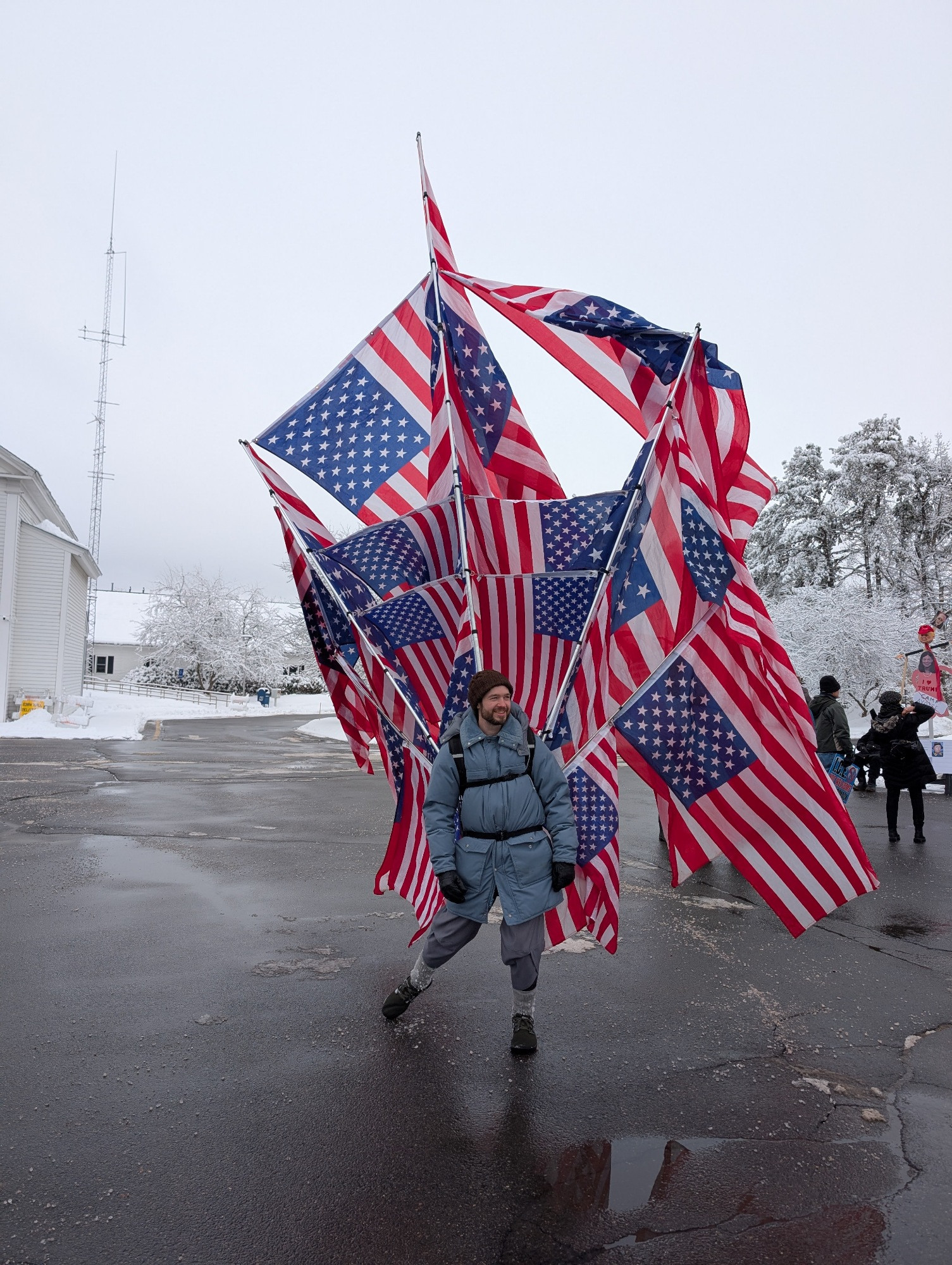
Man decked out with many US flags at Merrimack anti-ICE protestThere were some inspiring highlights, especially a man who stood on a huge snowbank decked out with many US flags. He looked like a human kite, and I almost worried that the wind would lift him into the air. People were there to oppose the human warehouse, which certainly would follow ICE’s usual standards for ignoring due process and treating people cruelly. Many were angry at Governor Ayotte, a modern-day Pontius Pilate who washes her hands of the whole thing.

I wore a small clip-on body camera and left my phone behind. It can’t track me, it’s inconspicuous, and it wouldn’t be as bad as losing a phone if anyone took it from me. Anyone who regularly goes to protests or observes ICE activity should consider getting one.

The crowd was big, and the atmosphere was friendly. I even ran into another member of my UU choir. At the same time, there were some aspects that made me uncomfortable.

There was a lot of chanting of obscenities. Now I’m aware that many on the left think insults and curses are the best way to win people over, but in practice it doesn’t work. When they don’t persuade people with their curses, they think their curses must not have been nasty enough. But I have to explain this, incredible as it may sound: Most people, hearing someone yell curses, don’t say, “Of course, that makes so much sense!” In fact, they’ve been known think that people who spew curses aren’t worth listening to.

There were lots of references to the facility as a “concentration camp.” It won’t be a “camp” of any kind. A concentration camp houses large numbers of people, usually based on ethnicity or culture, in barracks, makeshift buildings, or tents. In addition to the Nazis’ notorious concentration camps, examples include the British relocation of Boers during the Second Boer War and the United States’ internment of Japanese Americans during World War II. The building in Merrimack would crowd abductees to an indoor space with barely something to sleep on. The Germans’ concentration camps were a preliminary step to mass murder; others weren’t, though all were cruel to varying degrees. Let’s call a prison a prison.

The level of cursing and the widespread “concentration camp” terminology were new to me, as anti-ICE and anti-Trump protests go. We’ve heard “Alligator Auschwitz” before, which is wrong for different reasons.

Several signs treated Trump’s felony conviction as an important point. The conviction was for not treating hush money payments as campaign expenditures, which is quite minor compared to many other things he’s done. On the other hand, I didn’t see many references to his having over a hundred people killed at sea in unprovoked military attacks. They’re mass murder, and it hasn’t been stressed enough. People have even debated whether it’s OK to come back and finish off any survivors. That’s like asking whether it was legitimate for old-style pirates to make their captives walk the plank.

In times like these, though, we can’t be too picky about our allies. What’s important is that hundreds of people expressed their opposition to an inhumane government facility in New Hampshire.


How to write about chess   Recently updated !

Certain errors constantly appear in TV shows and movies portraying chess games. I’m no expert player, but I know the rules well and used to go to tournaments. Here’s a guide on mistakes to avoid.

The starting position

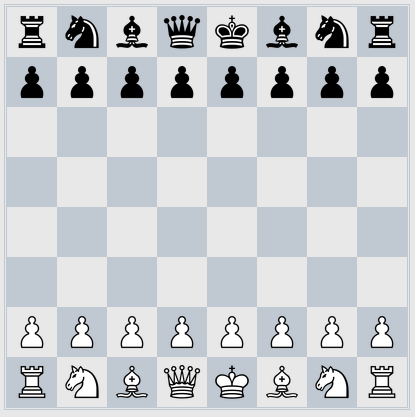
First, the board must be positioned correctly. The lower right square from each player’s viewpoint must be white. It’s amazingly common for illustrations and TV and movie games to get this wrong. See, for example, this well-known scene from The Seventh Seal.

Queen faces queen, king faces king. The white queen is on a white square, and the black queen is on a black square. Going outward from the queen and king are the bishops, knights, and rooks. The colors of the opposing sides don’t have to be black and white, though they’re called that by convention.

Starting position of a standard chess game

The play

Chess etiquette says that you leave your opponent undisturbed while they’re considering their move. You don’t rush them, even if they’ve been contemplating a full minute. A good player will always take time to consider the possibilities. Casual conversation during a game is unusual. Silence can make the scene dull, so the actors can speed up the play and perhaps have a conversation related to the plot. Avoid showing pressure on the opponent, unless it’s to show how rude a player is.

The moves in a visual presentation should be plausible. I don’t know who controls this, but probably the script writer isn’t expected to dictate each move. Maybe the actors pick their moves, or maybe the director does. Probably the game won’t be shown move for move, anyway.

The chess game in The Thomas Crown Affair is nicely done. The moves are plausible, and the players are quiet. The woman is trying to distract the man with her looks, but that’s presumably part of the story.

Terminology

A gambit is the offered sacrifice of a pawn in the game’s opening.

The pieces that look like crenellated towers are rooks, not castles.

A stalemate is a position where a player isn’t in check but has no legal move. The game is a draw. Draws by agreement or by other rules aren’t stalemates.

Checkmate out of nowhere

What really bugs me is the scene where a player effects a checkmate without the opponent seeing it coming. This happens only among beginners, but we see it all the time. In a normal game, one player will realize defeat is inevitable at least a few moves before the end. Yes, a checkmate out of nowhere is dramatic, but there are other ways to achieve drama. The player on the losing side can sense the noose tightening. The one with the advantage can announce, “Mate in four.” Then maybe the opponent will say. “I don’t think so … Damn it, you’re right. I resign.” Good actors can make more out of that than out of a sudden checkmate. Most games among competent players end with a draw or a resignation, rather than being played out to the checkmate.

A player can resign by saying “Resign,” or by tipping over the king.

Here’s an article with a long list of TV shows, movies, and comics with chess blunders.

These tips may not apply to chess variants. Speed chess is fun; it imposes a tight time limit on the players’ moves, so it could allow a livelier scene. No one knows the rules for Star Trek’s 3-D chess, so anything goes. But if you’re portraying a game of standard chess, these tips may help you to avoid mistakes without sacrificing drama.


“The Hunchback of Notre Dame” at Boskone   Recently updated !

At Boskone 63 in Boston, I stepped in twice as a movie accompanist. The first was a ten-minute film (and I mean film, the 16 millimeter kind) of scenes from the Seattle Worldcon. Then I noticed that on Sunday morning, the 1923 Hunchback of Notre Dame was scheduled, apparently with just whatever music came with the video. I made last-minute arrangements to accompany it. Zero practice, and I hadn’t brought my best keyboard, but I know the movie well.

We’re talking about my accompanying a properly scheduled silent feature film next year.


Don’t let a bot do your writing

A couple of days ago I was in a conversation where one of the people talked about letting an AI bot rewrite her business correspondence. She thought that her own style might seem abrupt and an appropriately directed chatbot could produce a less confrontational tone. Handing authorship to a bot is almost always a bad idea.

If it’s something purely utilitarian, like placing an order, then fine. Having software write up the request could save some time and make sure the numbers add up. But if it’s something the reader will care about, then it should come from you, not a machine. There’s still room for software to help you. A spelling and grammar checker can catch errors. I’ve used Grammarly and Language Tool. The important thing is to look at each suggestion and decide whether you want it. You can even have it check your tone, as long as you make the final decision yourself. Sometimes a “correction” will seriously change the meaning. The style might be wrong for your intended readers.

The point isn’t to flee from all forms of artificial intelligence. It’s to keep the content and voice yours. You may not be a pro-quality writer, but I’m sure nearly all of you reading this are competent. People would rather have something in your voice than something polished, grammatically correct, and fake-sounding.

If you let software be your full-time secretary, it will have a set of biases. Every creator of original text, human or machine, does. It will express views, perhaps subtly, by its choice of words and avoidance of topics or expressions. It will say things you wouldn’t.

Better to say things in your own way, improve your style as you go, and let your writing authentically represent you.