libraries


Gagging social media in Methuen 4

The city of Methuen, Massachusetts, has adopted a resolution to restrict access to social media on city-owned devices. The announcement states that “City-owned devices and networks in City buildings and City-run youth programs will limit access to social media for minors under 16 whenever feasible.” This would clearly apply to Methuen’s Nevins Library, which provides computers for public use.

The statement has the tone of fanaticism that’s gone so far over the edge that it doesn’t even require yelling; of course every reasonable person will agree with it, won’t you? It’s FOR THE CHILDREN! The council favorably cites Australia’s total ban on use of social media by anyone under 16. The statement expresses hope for nationwide restrictions: “The Council also formally endorsed Mayor Beauregard’s commitment to advocate for state and federal policies that restrict social media access for children under 16 and strengthen youth digital safety protections nationwide.”

It’s the familiar idea that libraries should reject or restrict access to anything deemed “harmful to minors,” where “harmful” has a very broad definition. It’s the same mindset that demands they keep all books on certain topics away from kids’ eyes.
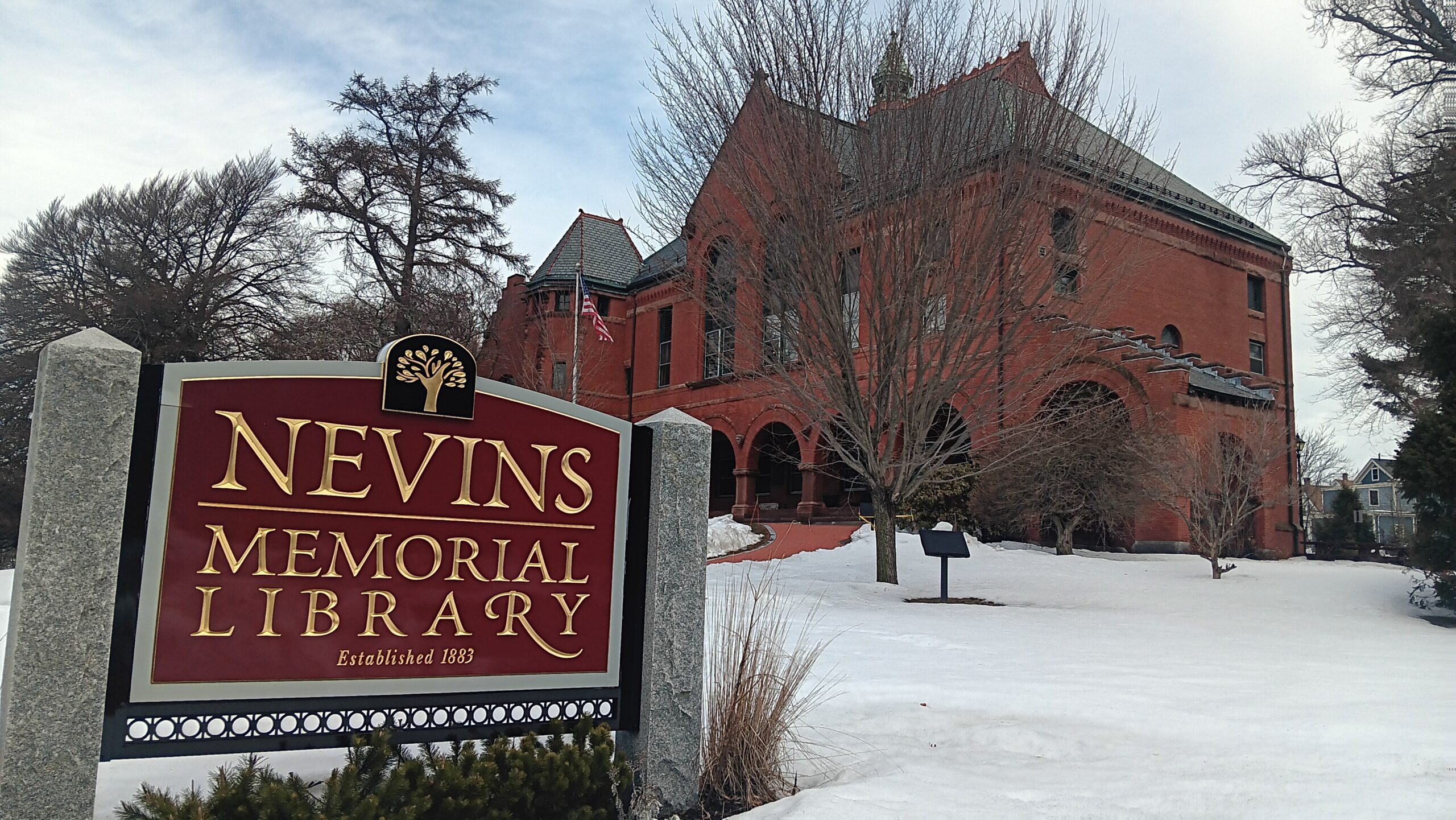
Nevins Memorial Library, Methuen, Mass.On Saturday I went to tne Nevins Library to find out how it’s going to be affected. The people working there said they hadn’t received any direct communication, even though the impact will fall most heavily on them. They don’t know what’s going to be expected of them.

The term “social media” can encompass any Internet service that enables public conversation. Restrictions on using social media are restrictions on discussion. Sometimes these discussions are vitally important to young people, especially if they’re dealing with domestic abuse or have issues they’re afraid to raise with their parents. They can help to get information for personal or educational reasons, and often people make friends from distant places and different cultures.

A lot of basic information is found on social media. YouTube is generally considered a social media site; anyone can upload videos, and most of them are open for comments. Many businesses use their Facebook page as their main Internet presence. Telling kids they can’t use these sites or subjecting them to heavy restrictions will cut them off from a lot of information.

The present situation is reminiscent of panics in which kids had to be “protected” from novels, comic books, rock’n’roll, TV, and video games. Who will protect us from the protectors?


New Hampshire libraries and free speech

Writing this makes me nervous. It deals with institutions I’m close to, and it’s one of those cases where both sides look bad. But it’s important to say it, and it might have a positive effect just because I’m so close. These events happened a while ago, but I just learned about them while researching something else. (That happens a lot.)

On one side we have Arlene Quaratiello, a minor New Hampshire politician and librarian who takes a restrictive view on what libraries should carry. On the other side we have the Dudley-Tucker Library in Raymond, New Hampshire, which violated her First Amendment rights. Quaratiello, who lives in Atkinson (which is also Karoline Leavitt’s home; what is it about that town?), wrote to a local news site endorsing two candidates for library trustee. She emailed a Republican Party chapter urging them to run conservative candidates for library trustee positions. Her letter advocated “protecting our children from the increasing amount of inappropriate material available … without sacrificing the intellectual freedom that has always characterized public libraries.”

This is at least worrisome, but it’s her right in the United States to express those views. She expressed them on her own time, using her personal resources. In spite of that, the Dudley-Tucker Library, where she was Assistant Director, terminated her. The reason given was “lack of separation of personal/political values and agendas from DTL policies, procedures, and occurrences” and that she supposedly was “not able to maintain the separation between personal and Library tenets.”
(more…)


My library tour

Somehow I thought I’d posted about this earlier, but I hadn’t on this blog. As a little summer project, I’m visiting every public library in Rockingham County, New Hampshire. Rockingham is in the southeastern part of the state and includes all of New Hampshire’s 18-mile seacoast. There are no big cities. Portsmouth, which I think is the only city in the county, has about 22,000 people. Three towns are bigger. The difference between a town and a city in this state is the form of government, not the population. Derry, the biggest town in the state at about 34,000, has two libraries, and the people at the smaller one in East Derry firmly say it’s not a branch library.
(more…)


A library tour on the NH seacoast 1

Thursday was a rainy day, chilly for late May, and I needed to do something to improve my mood, so I set out on an afternoon’s tour of libraries near the New Hampshire coastline. The towns in this region mostly have small land areas, and each other has its own library, so I could cover a lot without too much travel. The ones I put on my list were South Hampton, Seabrook, Hampton, Rye, and Stratham. On the way home I passed right by the East Kingston library, so I dropped in there, as well as the Plaistow library.
(more…)


New Hampshire bill seeks to mandate book rating system

A bill before the New Hampshire legislature, Senate Bill 523, is a frontal attack on school libraries in the state and the vendors that provide books to them. The bill is sponsored by State Senator Kevin Avard. It’s the kind of lunacy you’d expect in Kansas or Texas, not New Hampshire.

It would set up a bounty system for bringing complaints against material which is allegedly “harmful to minors.” Anyone claiming to be aggrieved under the bill’s terms would be able to sue for damages. A person bringing a successful suit would be guaranteed a minimum payout of $1,000. What Avard is trying to set up isn’t just a way to remove inappropriate books but a way to incentivize gratuitous challenges.
(more…)