The Sanity Project


Gagging social media in Methuen 4

The city of Methuen, Massachusetts, has adopted a resolution to restrict access to social media on city-owned devices. The announcement states that “City-owned devices and networks in City buildings and City-run youth programs will limit access to social media for minors under 16 whenever feasible.” This would clearly apply to Methuen’s Nevins Library, which provides computers for public use.

The statement has the tone of fanaticism that’s gone so far over the edge that it doesn’t even require yelling; of course every reasonable person will agree with it, won’t you? It’s FOR THE CHILDREN! The council favorably cites Australia’s total ban on use of social media by anyone under 16. The statement expresses hope for nationwide restrictions: “The Council also formally endorsed Mayor Beauregard’s commitment to advocate for state and federal policies that restrict social media access for children under 16 and strengthen youth digital safety protections nationwide.”

It’s the familiar idea that libraries should reject or restrict access to anything deemed “harmful to minors,” where “harmful” has a very broad definition. It’s the same mindset that demands they keep all books on certain topics away from kids’ eyes.
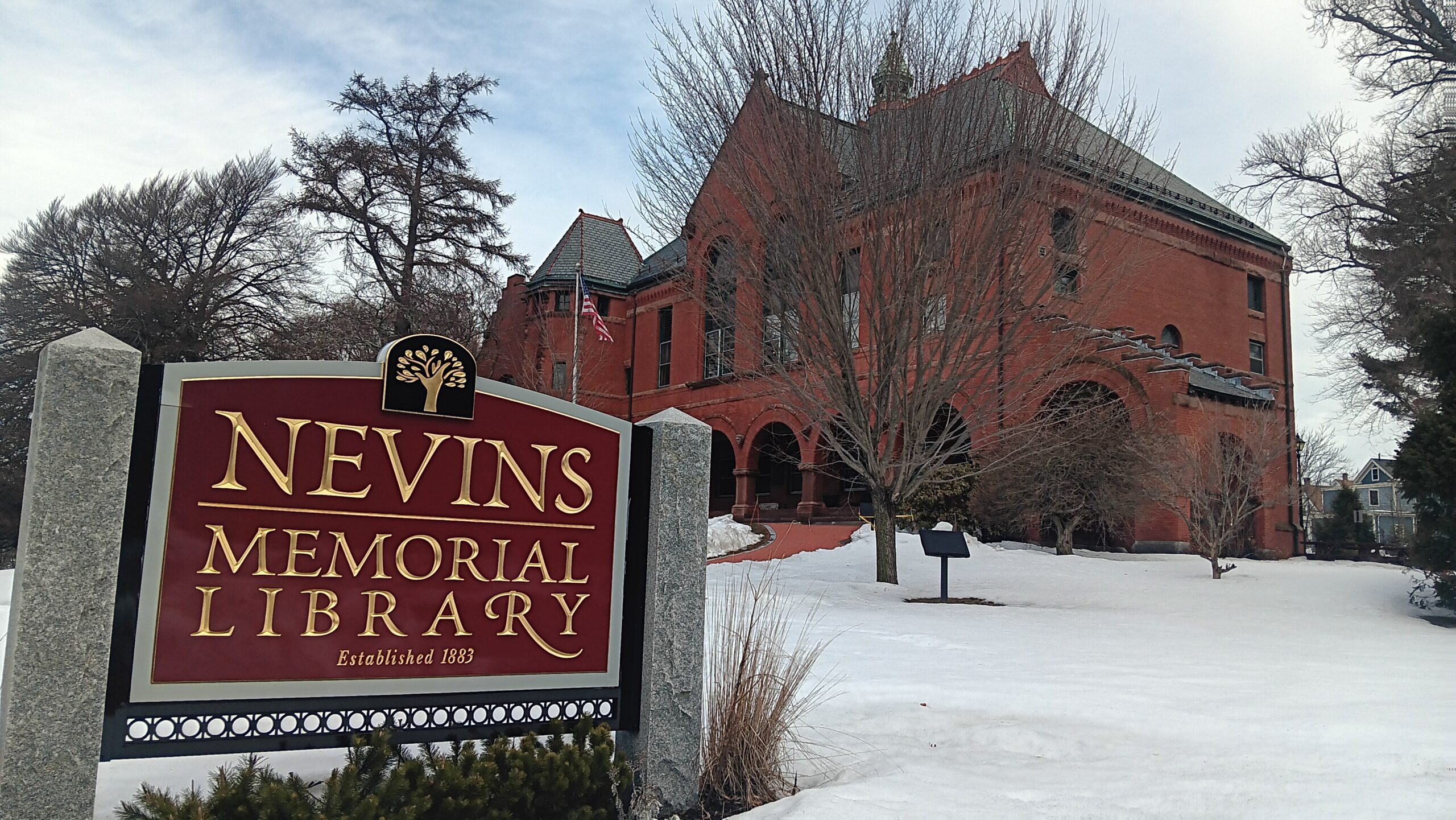
Nevins Memorial Library, Methuen, Mass.On Saturday I went to tne Nevins Library to find out how it’s going to be affected. The people working there said they hadn’t received any direct communication, even though the impact will fall most heavily on them. They don’t know what’s going to be expected of them.

The term “social media” can encompass any Internet service that enables public conversation. Restrictions on using social media are restrictions on discussion. Sometimes these discussions are vitally important to young people, especially if they’re dealing with domestic abuse or have issues they’re afraid to raise with their parents. They can help to get information for personal or educational reasons, and often people make friends from distant places and different cultures.

A lot of basic information is found on social media. YouTube is generally considered a social media site; anyone can upload videos, and most of them are open for comments. Many businesses use their Facebook page as their main Internet presence. Telling kids they can’t use these sites or subjecting them to heavy restrictions will cut them off from a lot of information.

The present situation is reminiscent of panics in which kids had to be “protected” from novels, comic books, rock’n’roll, TV, and video games. Who will protect us from the protectors?


A murder cult

In November, I wrote about people who advocate assaulting people they call Nazis. Bad as they are, they aren’t in the same league as people whose political views include endorsement of murder. This group is on the fringe, but it needs to be strongly repudiated.

A report that caught my attention recently says that “The man who allegedly opened fire at a country club in Nashua, N.H., last fall, killing a restaurant patron and wounding two other people, later confessed to the shooting and told investigators he wanted to kill the rich.” Many people on the left admire Luigi Mangione, who has been charged with killing insurance executive Brian Thompson in cold blood. Posts on social media express enthusiasm for France’s Reign of Terror, in which about 17,000 people were executed. The Chicago Teachers Union posted on pre-Musk Twitter applauding a death threat in the form of a mock guillotine.

I didn’t see much outright celebration of Charlie Kirk’s death, but the outburst of hatred following his death was far out of proportion to his views and inappropriate to the occasion. Last September, I posted about one aspect of that reaction.

These are people who believe individual human lives have no significance. If they can improve “society” by eliminating some of its members, they’re all for it. In previous generations, people with similar views cheered the killing of millions by Stalin and Mao.

These people have the right to express their views, so long as they aren’t directly threatening people. What they don’t have is the right to be considered anything better than human dirt. Teachers who applaud guillotines should be pariahs in educational communities. Talk show audiences who cheer for Mangione should be kicked out of the studio. People who post to social media advocating a new Reign of Terror should have their accounts suspended. People who believe in human rights in any form should make it clear they have nothing to do with admirers of murder.


Gugusse et l’Automate: Rediscovery of the first robot film

If you’ve seen the movie Hugo (and you should), you remember the wonderful scene where a humanoid automaton is restored and goes into action, revealing an important secret. Georges Méliès found these machines fascinating. His 1897 Gugusse et l’Automate presents an automaton (played by an actor) in what has been called the world’s first film about a robot. Bill McFarland brought a box of old films from Grand Rapids, Michigan to the National Audio-Visual Conservation Center in Virginia, and one of them was a third-generation copy of Gugusse. Film historians had known it existed, but no one now living had seen it. The preservation experts digitized the one-minute film, which I’m sure must have been fragile, and it’s now available freely on YouTube and other sites.

Here’s a link to the video on the LOC site. I’ve edited this post to link rather than embed, since the embed wasn’t always working.


Oligarchy: A conspiracy theory of the left 2

Oligarchy: Government by the few. (Merriam-Webster)

Claims from the left that certain people, usually very rich ones, are “oligarchs” of the USA are common. The Mother Jones website boasts at the top of every article that it’s “a source that’s not owned and controlled by oligarchs.” If the USA has oligarchs, it must be an oligarchy. That’s an odd claim, since most people think the country is a democracy. Perhaps a dysfunctional one, but still a government run by elected officials.

It’s true that Congress has grown more passive than ever, but if the US has ceased to be a democracy, what it has become is an autocracy under Donald Trump. Like Sauron, he doesn’t share power. Perhaps if you count the most powerful Cabinet members, such as Hegseth and Noem, and advisors like Miller, it’s an oligarchy. But that’s not what the oligarchy theorists are talking about. Their claims are a new version of the “secret masters” conspiracy theories, claiming people like Elon Musk and Jeff Bezos are the real puppet masters. In older versions, it was the Rothschilds or the Jewish Bankers. Some on the American right consider George Soros the leading Jewish oligarch. The new left-wing version differs mainly in its lack of overt antisemitism (though even that has started to change in the last couple of years).

There’s a long history of claims that a small number of people without official power run countries or even the whole world. The “iron law of oligarchy” claims that all governments eventually devolve into oligarchies. The people nominally in charge take orders from them because of financial pressure or blackmail. In this scenario, the president is merely a front man. This raises an obvious question: Why would they pick Donald Trump as their puppet? You’d think they’d pick someone who’s more competent, predictable, and superficially respectable.

Conspiracy theories aren’t grounded in evidence or plausibility. They rest on emotional satisfaction. If a cabal of the rich is running America, they’re a target to blame everything on. They’re incredibly rich, so they’re not like “us.” Nobody voted for them, so the voters are absolved of guilt.

But the bitter truth is that officials elected by Americans, not puppeteers behind the scenes, are responsible for what has happened to America.


Book discussion: Fighting for the Freedom to Learn

The history of what’s known as “school choice” is more convoluted than I had realized. Fighting for the Freedom to Learn, from the Cato Institute, maps out that history in a set of twelve essays by different authors. Together, they add up to a narrative from the colonial era to modern times in the United States. The book is less polemic than its title may sound, providing a lot of information for anyone interested in the history of American education.

This isn’t an area where I have much knowledge, so I can’t say confidently how accurate it is. I can say that it presents an informational tone, has lots of end notes, and doesn’t say anything that looks obviously suspicious.

Most people today look at advocacy of school choice as an exclusively right-wing issue. (Everything today is a right-wing or left-wing issue.) In the past, though, it’s been complicated. Today we think of public schools as secular institutions, but for much of our history they were tools of nativist Protestant hegemony. I’m old enough to remember being told in school to pray to “Our Father.” In the first half of the nineteenth century,

A crucial factor of the development of the state role in education was an expansion of the concept of the citizen. With increased discussion of alternative forms of political authority, there was a renewed appreciation of Aristotle’s argument that citizens should be shaped by state-directed education to match the form of government under which they would live.

The concern increased along with the growth in Irish immigration, which was mostly Catholic. Senator James Blaine promoted state constitutional amendments, as well as unsuccessfully urging a national one, barring the granting of government funds to religious schools, while insisting that they could “not be construed to prohibit the reading of the Bible in any school or Institution.” By “the Bible,” he meant the King James Bible. The target of the amendments was Catholic schools.

The authors acknowledge that following the Supreme Court’s Brown decision and the Civil Rights Act, many segregationists saw private schools as a way to maintain racial purity, but they insist this is far from the whole story. Public schools with predominantly black student bodies often got a bad deal (and sometimes still do).

Throughout American history, people from all walks of life have sought educational options for a variety of pressing reasons, most of them rooted in freedom. The roots on the left are deep and fascinating. They are found in the centuries-old struggle for educational opportunity in the black experience, in the liberal academics who saw vouchers as a tool in the War on Poverty, in the counterculture dissidents who sparked the “free schools” and homeschooling movements, and even, for 20 years, in the Democratic Party’s national platform.

There’s a lot to learn from this book. I recommend it to people interested in American educational history.