The Sanity Project


ICE watching in New Hampshire

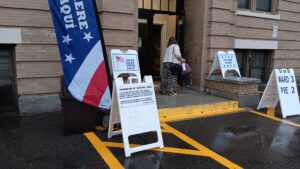
For the second Tuesday in a row, I hung around a polling location with a clip-on camera, in case the Feds tried anything. Except for an ambulance taking someone away, presumably because of a medical issue and not violence, nothing out of the ordinary happened. I got noticed, though.

The amusing thing was a guy standing outside with a Scott Brown sign. Brown was one of the two leading candidates for the Republican Senate nomination; he lost to John Sununu. Sununu has Trump’s endorsement, but Brown is as bad. Sununu supports the SAVE Bill and wants the government to ignore the Constitution’s birthright citizenship clause. I barely looked at the sign holder, but every time I walked by, he tried to talk with me. I don’t know what he was thinking; his comments were just weak attempts at conversation starting. He must have noticed the camera, though, and I’m hoping that he was nervous because of that. At one point he suggested I pick up a Goodlander sign that was lying on the ground, though I’d shown no sign of partisan preference; Goodlander has won respect for standing up to Trump’s call for her execution.

That’s not much. One guy with a camera maybe making one Trumpist worry that if ICE goons showed up, they could be caught on camera. But if lots of people are watching the polls in November, it could make ICE less inclined to intimidate people. And if it still does, there will be more video records of its action.

It’s not much, but it’s something.


SUBSCRIBE

Enter your email address to subscribe and get notifications of new posts by email.


Publicizing those worth publicizing

Many people on social media put their efforts into pointing out ridiculous or nasty statements. Sometimes denunciation is necessary, but it shouldn’t be anyone’s main focus. It gives publicity to bad ideas. When a lot of people do it, it makes them part of the dominant dialogue. It draws attention away from people with more reasonable and better argued positions. Some people will find the nonsense interesting and even convincing.

Focusing on people with good things to say and solid arguments behind them draws attention to them, and usually that’s helpful. People can learn something from them, which is more than they can do from the words of fools.

I’m not saying that “Any publicity is good publicity” is literally true. There have been plenty of cases where people have said unpopular things and suffered a loss of business and reputation. But repeatedly hearing an idea can make it seem more acceptable. Anyone who already felt sympathy for it might feel less marginalized.

People need to rally around good ideas more than they need to denounce bad ones. If they only hear that bad ideas are bad, they’ll become discouraged or cynical. Without good ones, you don’t even have a standard that lets you reject the bad ones. Tyranny is bad because freedom is good. Socialism is bad because individual autonomy is good. Murder is bad because human life is good. Bad ideas can be worth dissecting, but you need a framework to do it.

As George Washington may or may not have said, let’s raise a standard to which the wise and honest can repair.

Note: I accidentally published a fragmentary draft on freedom of expression in Bow, NH. I immediately deleted it, so probably only the people who get email notifications saw it. Sorry.


SUBSCRIBE

Enter your email address to subscribe and get notifications of new posts by email.


ICE watching in Haverhill

Donald Trump has refused to rule out sending ICE agents to the polls, even though sending armed federal agents to a polling place is illegal. They wouldn’t have to do anything beyond being there to intimidate voters, and their presence in well-chosen places could influence an election’s outcome.

We can discourage it by making sure there are observers at high-risk locations to record them if they show up. Big Brother, knowing he’s the one being watched, may be more reluctant to follow through. Knowing this, on September 1 I went to the City Hall in Haverhill, Mass., a polling place for the state primary. It’s less likely ICE would interfere with the primary, but it’s good practice and establishes my commitment for November. Next week I have similar plans for the New Hampshire primary, though I haven’t decided where. I chose the Haverhill location because a valued friend was working at the polls there.

Entrance to voting at Haverhill, MA City HallIt was boring work, which is a good thing. It was also miserable weather. Part way through the morning, I had to go home and change into dry socks. I was standing intermittently for four hours, which says I’m in better shape than I thought. Forgetting that ultraviolet doesn’t care about clouds, I got a slight sunburn on my ear.

Did I accomplish anything? I made a few people aware someone was standing by with a camera in case anything nasty happened. While I was there, I had a friendly conversation with the cop who was stationed there and told some of the poll workers what I was doing; my friend probably explained further when I wasn’t there. I went outside and got some exercise. On top of that, for a few hours I was pushing back against the intimidation of Americans.

It was worth it. It will be worth it again next week, even if it’s as boring as I hope it will be.


SUBSCRIBE

Enter your email address to subscribe and get notifications of new posts by email.


Thoughts on Don Giovanni

This article originally appeared on Leaflet, where it hasn’t gotten much traffic. It’s a decent article, so I’m reposting it here with some small tweaks.


Don Giovanni is one of Mozart’s most popular operas. The title character is clearly the villain; he attempts rape and commits a murder in the first scene, and he has a long history of seducing women and walking away from them. In the final scene, though, something strange happens. It’s easy to feel sympathy for him. He hasn’t actually earned any, so what’s happening?

Here’s a quick summary for anyone unfamiliar with the opera. Don Giovanni (the Italian name for Don Juan) is driven off by Donna Anna, whom he had just attacked (“date rape” would be the modern term). Her father, the Commendatore, challenges him, and Don Giovanni easily kills the older man. Later on, Giovanni finds a statue of the Commendatore, which speaks to him. He invites the statue to dinner. The Commendatore’s statue walks into Giovanni’s home and demands that he repent. Giovanni refuses, and demons drag him to Hell.

What happens between these scenes establishes that Don Giovanni is a scoundrel. Why, then, object to his damnation? (Aside from objections to the idea of eternal punishment, which aren’t the point here.) Because Mozart was brilliant and used his musical skills to flip the moral landscape. (He did that in The Magic Flute as well, though the situation there is quite different.)

Leporello’s panic on seeing the Commendatore sets the mood. The music when he enters is some of the most terrifying Mozart wrote. Giovanni responds politely and courageously, even when the statue grasps his hand with an unbreakable, freezing grip.

While the statue supposedly is a messenger from heaven, offering a last chance for salvation, he feels like an emissary from Hell. Don Giovanni is a human being, even if he’s a very bad one, standing up to a statue animated by supernatural forces. If we’re supposed to understand that these forces are doing God’s dirty work for him, that’s even worse. We side with human courage and defiance.

After his scream dies away, the other characters enter, and Mozart tries to reset the moral balance. The concluding scene is weak by comparison. Maybe that was his intention.

If you find yourself echoing Giovanni’s cries of “No!” it’s all right. It doesn’t mean you approve of people who do what he did. It just means that you understand and respond to courage, even when it’s misapplied, and especially when Mozart is underscoring the conflict with his music.

 
On another part of the opera: In Taking Funny Music Seriously (an excellent book, by the way), author Lily E. Hirsch takes issue with Leporello’s “Madamina” aria, where he details his master’s activities. Hirsch says the aria is “more disgusting and disturbing than funny, though [Mozart’s] librettist must of course share some of the blame.” She claims there’s an “assumption that the titular character is somehow a hero.”

Elsewhere in the book, she has a whole chapter on funny songs about death, including a couple by Tom Lehrer on a nuclear holocaust, and she doesn’t call them “disgusting and disturbing.” The opera shows Giovanni being repeatedly cruel and getting his comeuppance, so it would take a warped mind to consider him a hero. I’ve just discussed the final scene, where he draws some sympathy but still isn’t a hero.

The song contributes to the picture of the protagonist as indifferent to the people he harms. The humor is in the gross exaggeration, combined with Leporello’s meticulous record-keeping. In Spain alone, he’s recorded 1,003 conquests, all written down in the book. These numbers are part of the setup for a well-deserved downfall.

SUBSCRIBE

Enter your email address to subscribe and get notifications of new posts by email.