Monthly Archives: March 2026


Three silent shorts, April 7

My next silent film show at the Plaistow Library will be on Tuesday, April 7. This time I’ll accompany three short comedies:

  • The Immigrant with Charlie Chaplin
  • Dr. Pyckle and Mr. Pryde with Stan Laurel
  • His Royal Slyness with Harold Lloyd

Chaplin, Laurel, and Lloyd were major comedy stars in their time. I shouldn’t have to say much about Chaplin. Stan Laurel’s career peaked after he joined with Oliver Hardy, but before that he had some excellent films on his own. Harold Lloyd’s “glasses” persona was a middle-class character, best known for his image hanging from a clock tower in Safety Last.

The Immigrant isn’t very controversial, in spite of its title. It has two distinct parts. The first shows Chaplin coming to America on a crowded boat from an unspecified country and helping a young woman whose money has been stolen. In the second part, he goes into the restaurant with a silver dollar he has found and encounters the young lady again. He discovers that the coin has fallen through a hole in his pocket and he has nothing to pay with. All turns out well, though.

I love mad scientists, Dr. Pyckle and Mr. Pryde is a great parody of John Barrymore’s 1920 Dr. Jekyll and Mr. Hyde. In this version, the doctor turns into not a murderous fiend but a silly prankster. The ending is lost, and what we have ends on a cliffhanger as a crowd breaks into the lab to save Pyckle’s assistant from Pryde. I’ll handle it by continuing to play, accompanying the way I think the film would have ended.

Finally, His Royal Slyness has a book salesman, played by Harold Lloyd, impersonate a prince and compete for a princess’s hand. The salesman looks just like the real prince, and you see them together on screen. No trick photography was used. Harold’s brother Gaylord looked a lot like him, and with glasses and makeup, they were nearly impossible to tell apart. Gaylord plays the real prince, who changes his mind about the deal and tries to claim the princess.

It’s a change of pace for me. The three movies together don’t run much over an hour, but they provide some of the best laughs of the period. They’re still fun today, and I aim to make them more fun with my accompaniment. Each one his its own keyboard setup, with a couple of surprises programmed in. If you’re in the area and it sounds interesting, drop by the Plaistow Library on April 7 at 6:00 PM.

This summer, the library will have some special events for the 250th anniversary of the Declaration of Independence. On of them will be D. W. Griffith’s America, an epic presentation of the American Revolution. The date hasn’t been set yet.

A note on comment notifications

When a comment gets posted to my blog, the server sends me an email to let me know. In most cases it lands in my spam folder, and with good reason. WordPress is doing something dumb.

The email is using the “From” address which the commenter provided. With modern SPF, DMARC, and DKIM protocols, which are almost mandatory today, the owner of an email account indicates which servers are authorized to use its address. The receiving IMAP or POP server will check if it came from an authorized IP address. If it didn’t, the server may mark it as spam or block it completely. Failure to do authentication properly is one of the biggest reasons legitimate mail gets flagged.

People posting comments on my blog aren’t going to authorize my WordPress server to send email for them. When my personal email server gets a message with a “From” address that belongs to the commenter but a received-mail path that comes from the website server, it looks exactly like impersonation. Technically, it is.

I don’t know why WordPress does it this way. It could use a “From” address on garymcgath.com for comment notifications, and the mail would almost certainly get through.

This means I usually don’t see comment notifications, so it may take longer for me to reply. Sorry.


The anti-thinkers

In the long view of world history, there has been gradual progress toward more well-being and freedom. It’s hard to see it right now, since the past couple of decades have seen a decline, but the long-term trend remains. In many countries you can usually travel freely, criticize the government, and follow the religion of your choice. Four hundred years ago you wouldn’t have seen much of that anywhere.

What has made it possible is people who think. They’ve shown that people who are free to make choices are better off than people under the heel of authority. Often they’ve been inconsistent, but they’ve pointed the world in the right direction.

Most people find thinking uncomfortable, though. It carries the risk of discovering one’s beliefs are wrong. It means uncertainty about what to do. Most people would rather have a set of beliefs which they don’t need to question. They’ll think only within safe bounds, on matters that don’t challenge their worldview. In most cases this just means laziness, but some actively reject reason. They don’t aim to understand reality, but to shape it by making assertions. They’re anti-thinkers.

“Mr. Shouter” in my earlier post is a perfect example of the anti-thinker. Anyone who disagrees with him is a “liar” and “Communist.” He thinks his conclusions are valid because he proclaims them loudly, and disagreement with him is proof of evil.

What can you do with such people? Trying to persuade them just wastes your time and raises your blood pressure. Still, it’s important to discourage them and limit their influence, especially if there’s an audience. Don’t lose your temper or resort to cursing or violence. Keep the high ground. You can say “You don’t know what you’re talking about” or “I’ll come back when you have some reasons to offer.” If you’re dealing with really nasty stuff, such as advocacy of violence, you can say, “That’s not only wrong, it’s disgusting.” Then walk away from the discussion.

Don’t assume anyone who disagrees is an anti-thinker, though. People can be confused and honestly have the facts wrong, and sometimes what sounds weird turns out to be right. Some people are intellectually lazy but not aggressively irrational. But when you encounter refusal to present a coherent case, appeal to emotions alone, accusations against you, and the appeal to authority, you’re facing an anti-thinker. Unless it’s to demolish their case for an audience, such people aren’t worth your time and don’t deserve your attention.

Turning your back deprives them of the respect they think they’re entitled to. It encourages others to think more clearly. To whatever level you make a difference, you’re pushing the general discourse in a better direction.

Of course, reflect on what you’re saying, and don’t dismiss people too quickly. You can be wrong, too. Sometimes you’ll need to improve your arguments or change your conclusions.


A Boston trip and a character snapshot 3

Saturday was an excellent first day of spring. I went to listen to the Boston Bach Birthday celebration at the First Lutheran Church. They had all-day performances, mostly on the organ, and a German lunch with bratwurst and sauerkraut. The lunch was a rare opportunity; there are no German restaurants in the area. The music included two recently discovered chaconnes by Bach, maybe their first public performance in Boston. It also included group singing of some old hymns, including one from Luther’s German Mass, which is 500 years old this year. They got this atheist singing hymns in a Lutheran church. 😇

It was sunny and about 50 degrees outside. After lunch I walked through the Public Garden and Boston Common. Near Park Street Station I saw a small group protesting the US oil blockade of Cuba. A guy (let’s call him Mr. Shouter) started yelling at them. I and another man I don’t know (Mr. Talker) went over to talk to him; my aim was just to distract him from a potentially nasty confrontation. In the few minutes we were there, I got some impressions of how that kind of mind works.

Cuba Blockade Protest, March 21, 2026, Boston CommonMr. Shouter was yelling that Cuba has a Communist government. True enough. He also yelled that dissent was impossible in Cuba because anyone who criticized the government would be shot and sent to a concentration camp. It wasn’t clear in which order. Granted, dissent in Cuba is dangerous, even if he exaggerated. I tried to tell him that a large part of that was true, but the best way to weaken Cuba’s rulers was open trade. Cuba hasn’t been a threat to the US at least since the Soviet Union collapsed. He didn’t reply to me or give me much notice; he was more interested in what Mr. Talker said. Talker told him that he had visited Cuba and that it was impossible to stop Cubans from speaking out. Shouter called him a Communist and a liar. Talker didn’t lose his temper. After a little while, I said quietly to Shouter, “If you’d stop yelling long enough to hear what others say, you might learn something,” and went down into the subway station.

We’ve all seen people like Shouter, who always yell and never listen. They’re a cliché of TV and movies, often drawing the protagonist into an unwanted fight. It isn’t other people they’re trying to keep from hearing disagreement. It’s themselves. They’re convinced the world is a certain way, but they know their certainty is built on shaky ground. If they stopped screaming, they might have to think about what they heard. He wasn’t entirely wrong. Cuba lacks freedom of speech, and maybe Talker thought they have more than they do. But Shouter saw its government as incredibly efficient in finding and stamping out every dissenting voice, like Orwell’s Big Brother. He was desperate to banish any possibility that open dissent exists in Cuba. Havana has seen several protests recently, at considerable risk to the participants, but he needs to believe that doesn’t happen.

Weird as it is, some people get satisfaction from believing their foes are all-powerful. Maybe it’s that the greater the enemy is, the greater the victory will be. It’s a literally apocalyptic way of thinking, straight out of the Book of Revelation.

Hopefully Talker and I helped to avoid a nasty scene. I didn’t see anything about the Cuba protesters in the news, which likely means nothing newsworthy happened.

Travel advisory

A special note for today: Trump is deploying ICE to airports. If you have a scheduled flight that isn’t strictly necessary, seriously consider cancelling. Somalis will be targeted; if you have any connection to Somalia, cancel the flight unless it’s a matter of life or death. If you must fly, don’t make an idiot of yourself. Find a way to get where you’re going without exposing yourself to more risk than necessary.


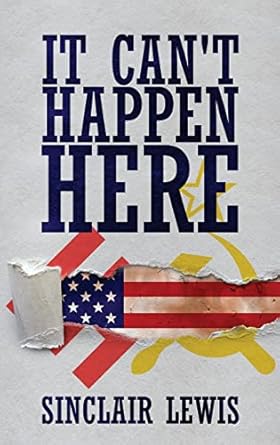
Book discussion: It Can’t Happen Here

Sinclair Lewis’s novel of an American dictatorship, It Can’t Happen Here, seems even more timely today than when it was published in 1935. It tells of the election of Buzz Windrip as president, his seizure of absolute power, and how it affects people.

Cover of It Can't Happen Here by Sinclair LewisWindrip is so Trump-like you might think Lewis had a crystal ball looking into our present. He aims for total control while posturing as an ordinary, unassuming person. His platform is incoherent, laced with bigotry while appealing to the “Forgotten Man.” His Cabinet selections are based on personal loyalty. He has a personal police force, the “Minute Men,” to intimidate his critics. He even has an advisor who is smarter and more ruthless than he is.

What make’s Windrip’s success possible is the complacency and indifference of the American people. As he plainly says he’s going to reduce Congress to an advisory capacity, people think he’s just going to fix the country up. The novel’s main focus isn’t on the centers of power but on Doremus Jessup, the publisher of a small Vermont newspaper who’s trying to make sense of it all. This lets Lewis show how people react to Windrip before and after his takeover. Once he’s in office, he immediately suppresses the legislative and judicial branches, which give him no further trouble.

Lewis had seen what had happened in twentieth-century Russia, Germany, and Italy. He knew the USA wasn’t immune. Reading the novel gives a better understanding of what’s happening — and what could happen — today.