liberty


Where do atheists in America stand?

Atheists in modern America enjoy a high level of religious freedom. In New England, where I live, we also enjoy a good level of acceptance. I don’t encounter hostility for being an atheist. Once the Eagle Tribune in Massachusetts mentioned on its front page that I am one; no one minded. But conditions can change, and there have been some signs of growing hostility to people who don’t think there’s a deity.

Pausing for a definition: I define “atheist” as a person who does not believe in a deity, not as a person who affirmatively believes there isn’t a God. Arguing for the non-existence of a vaguely defined being is a hopeless task; let those who claim there is one define their terms and offer their arguments.

There has always been hostility to atheism. Lately, though, it’s become a bit bolder, with backing by the White House. On June 24, 2023, Donald Trump said, “Together, we’re warriors in a righteous crusade to stop the arsonists, the atheists, globalists, and the Marxists.” In 2025, Trump formed a so-called “Religious Liberty Commission” with the ostensible purpose of identifying threats to religious freedom. Every member appointed to it was Christian or Jewish (with an overwhelming Christian majority). No Muslims, atheists, Hindus, or pagans. That’s like having a coastal flooding commission whose members are all from Colorado, North Dakota, and Kansas.

A White House report on domestic terrorism claimed that “anti-Americanism, anti-capitalism, and anti-Christianity” animate violent conduct against American institutions.

At a White House Faith Office luncheon, Trump threatened any atheists who might be in the room: “Is there an atheist in the room? Any atheists? I don’t think so. I wouldn’t want to raise my hand if I were. You’d be in big trouble.”

Eight state constitutions, mostly in the South, specify religious tests for holding office. They’re dead letters at present, but it was only in 1961 that the Supreme Court ruled that states couldn’t require a statement of religious belief before a person could hold public office.

What are the actual risks? Outright denial of religious freedom isn’t likely to become a major problem. There are always bigots in local offices who abuse their power, but they’ll lose when challenged in court. A greater risk is that views outside Christianity may be lowered in some ways to second-class status. In some ways, they have been for a long time. The currency says “In God we trust” and the pledge to the flag says we’re “one nation, under God.” Those are just annoyances, though. It’s more ominous that a large minority wants to turn the US into a “Christian nation.” The First Amendment and mountains of legal precedent stand in their way, but a determined government can make life difficult for the non-religious without explicitly targeting them. The non-profit status of irreligious organizations and non-theistic churches can be attacked for made-up reasons. Religious affiliation is often a de facto qualification for high-level appointments, and the situation could get worse.

I’m not particularly worried at present, but things can change with alarming speed. It’s important to watch for signs.

The special nastiness of the left 1

There’s no shortage of nastiness from either the left or the right these days, but it’s always seemed to me that the flavor coming from the left has something special, which is especially good at driving people away. This is separate from whether their aims are a greater threat. What I see a kind of elitism. What I’m saying here is based on my own impressions, not systematic study. Although the attitudes I’m discussing are elitist, I’m talking about ordinary people, not ones in high positions.

A lot of people on the left can be pleasant to deal with. The points I’m making here don’t apply to them all, by any means. It just doesn’t take a lot to make a lasting bad impression. I grant that if I were Mexican, Arabic, or trans, I’d experience vastly more hostility from the right.

Elitism, like populism, is tricky to identify. We all think we’re better than other people. Elitism is more than that; it’s an attitude of inherent superiority. It divides the world into the virtuous few and the despicable outsiders, and it polices its own members.

This attitude is the opposite of the populism I discussed last time. It’s manifested in attitudes of superiority to the masses. When people act this way, they’re effectively saying no one else is worthy to talk with them. However, both take a static view of people; everyone is a certain way and can’t (or had better not) change. People on the left often boast that “everyone is welcome” among them, yet in practice they have little tolerance for deviant ideas. The left and right can both come down hard on full-blown opposition, but people on the right are less likely to denounce people for limited disagreement.

Many throw accusations of “racist,” “fascist,” and “Nazi” around as freely as Joe McCarthy issued accusations of Communism. Some use the threat to keep people in line. One person threatened that people would start calling me racist if I disagreed with a proposal of hers, and she admitted the accusation would be false. Others have skipped that step and gone straight to the accusation.

People of this type like to build accusations out of nothing. The word “Gypsy” used to be commonly applied to the ethnic group now generally called Roma. It may not have been the best choice, but most people who used the term didn’t intend it as an insult any more than “Mexican” or “Chinese” is an insult. However, the notion that it was a nasty slur caught on. I recall a singer who used to have a song in her repertoire about “gypsies.” One day she came out and apologized in the most abject terms for having ever sung it. I know enough about both her and the song to know she meant nothing derogatory about it. She must have been threatened with ferocious denunciation if she didn’t get down on her knees.

I wrote a few years ago about how SFWA smeared a prominent writer by claiming she used an unspecified “racial slur.” The word she used, it eventually came out, was “colored.” Does SFWA claim that the National Association for the Advancement of Colored People (NAACP) engages in racial smears on all its letterheads?

Giving people the benefit of the doubt and letting others defend them against accusations are basic principles of fairness. Sometimes, though, they’re unpopular ideas. A Mastodon site still bans defending people against accusations, even if they’re just “devil’s advocate” arguments. In that respect, the site is less tolerant than the medieval Catholic Church. Access to what others are saying isn’t always popular; a popular Mastodon client “rickrolls” attempts to access servers that the developers disapprove of.

Conservatives have sometimes reached out to libertarians, while the left has more often been fiercely hostile. This helps to explain why so many self-proclaimed “libertarians” have taken Trump’s side. Supporting Trump is dumb, but was it really necessary to drive us away?

In a sane society, the MAGA movement would be denounced almost everywhere, and the politicians who have pinned their careers to it wouldn’t be comfortable showing their faces in public. But that would require people who disagree on many things to agree that the current situation is so bad we need to put our differences aside for a while. Instead, there’s often a sense on the left that their purity comes above all else and anyone who isn’t fully with them deserves denunciation. That goes a long way to account for where we are.


Sloppy rhetoric kills credibility 5

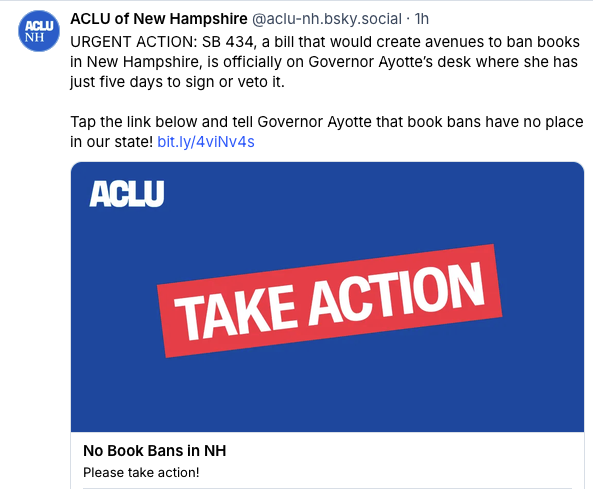
The ACLU of New Hampshire has taken a position against New Hampshire SB 434, which it characterizes as “a bill to create avenues to ban books in New Hampshire.” As the word “ban” is normally understood in the legal sense, it means to categorically prohibit. A banned book is one that it’s illegal to own or distribute. The bill may be a bad one, but that’s not what it would do.
Bluesky screenshot from ACLU of New Hampshire

Governor Ayotte has vetoed the bill, so the issue is effectively dead for now. An override is possible but unlikely. What I’m writing about here is how the NH ACLU framed the issue.

The bill would have created a mechanism by which parents or guardians can challenge a book that’s available in a public school as “obscene and harmful to minors.” Successfully challenged books would not be “banned in New Hampshire”; anyone could still get them through the usual markets. Arguably it makes it too easy to challenge books based on little or no knowledge of their content, but schools already can and do exclude books. In most cases, it’s just that they can’t get every book that’s in print, but sometimes it’s because the books are badly written garbage. If intentionally excluding a book is “banning,” then every school already “bans” books.

There’s legitimate concern that making challenges easier would lead to the exclusion of books that have real value. But the point is not that schools should indiscriminately carry any and all books, or that any policy that excludes some books “bans” them.

In her veto statement, Ayotte correctly framed the issue as one of policy: “As a parent, I understand and appreciate the concerns parents have about their children being exposed to age-inappropriate or objectionable materials in schools. At the same time, existing New Hampshire law already requires school districts to adopt a policy allowing an exception to specific course material based on a parent’s determination that the material is objectionable.”

In its call for action, the NH ACLU claimed, “The right to free expression includes the freedom to read whatever we choose. Yet our state government is attempting to make it easier to ban books right here in New Hampshire.” You have the right to read whatever you choose, but not the right to get it for free. It isn’t “banning” to say you have to pay for something out of your own pocket.

How schools select books is an important issue. A challenge procedure that encourages moral panics could be very bad, pushing schools into carrying only the safest books. But it’s a policy issue, not a rights issue. The real threats to free expression are growing: intimidation and even arrests of people who criticize officials, groundless lawsuits against news sources backed by threats of executive action, proposals for Internet censorship. If people who are already skeptical see library policies called “book bans,” they won’t pay as much attention to the real dangers to liberty.

There has been real book banning in the United States. The Comstock Act criminalized mailing “obscene” material, such as information on birth control. It’s never been repealed, though court rulings have greatly narrowed it. The owners of a bookstore in San Francisco were arrested and prosecuted for carrying Howl and Other Poems by Allan Ginsberg, eventually winning a landmark case. Such prosecution is rare today, but it could come back.

It’s especially bad when a chapter of the ACLU trivializes the concept. When individuals, even well-known ones, abuse the language, it mostly reflects on them personally. When a civil liberties organization does it, it damages the cause of civil liberties.


The expropriation of creativity

Socialist Bernie Sanders has proposed that the federal government seize 50% of the stock of businesses that are heavily involved in AI. It’s the classic socialist line that all creation comes out of “the people” and not specific people. It aims to expropriate not just wealth but credit for achievements.

Artificial intelligence was not created out of thin air. The data and language used by generative A.I. tools didn’t just pop into Sam Altman’s head or Elon Musk’s imagination. A.I. is built on our collective intelligence: our books, songs, artwork, journalism, computer code, scientific research, videos, conversations, images and ideas spanning generations. That is not just the opinion of Bernie Sanders.

 
For the most part, tech oligarchs have fed this knowledge into their A.I. models without permission, without acknowledgment, without compensation. In other words, the creative work of millions of people — writers, artists, musicians, journalists, teachers, scientists and ordinary citizens — has essentially been stolen by some of the wealthiest people in the world. It’s time for us to reclaim it.

 
Since A.I. is built on the collective knowledge of humanity, the wealth it generates must benefit humanity.

Face of a Borg of Star TrekThe first sentence is definitely true. AI software wasn’t “created out of thin air.” Nor was it created by some Borg-like “collective intelligence.” AI code, like any other, is created by people putting in long hours to turn abstract algorithms and data flows into code.

The term “artificial intelligence” is a vague one. Any software that does things that we previously thought only a human mind can do counts as AI. But eventually we get used to things like speech recognition, grandmaster-level chess, and self-driving cars and forget to call them AI. The current fad is large language models (LLMs), a brute-force technique that ingests vast amounts of information and spews it back out in new combinations. It’s encountered hostility because it’s shoved in our faces so much and isn’t especially reliable. Companies brag that they put “AI first,” which means that users are second at best.

There are legitimate concerns about LLMs grabbing up people’s research and creative work without credit or compensation. Many lawsuits have been filed over the matter. But the work they’re grabbing up isn’t the product of the collective hive mind either. It’s specific creations by specific people. When Sanders says “us,” he means the federal government, the monster which Trump currently exercises broad control over. Having the US government splitting the take with the companies doesn’t compensate creators or grant them credit. It especially ignores creators outside the US border. Advocates of the collective-mind hypothesis often regard the government as its embodiment, but a quick look shows how absurd that claim is.

Maybe Sanders thinks AI wasn’t invented till last year, consists only of LLMs, and works by stirring large amounts of information in a cauldron. Even assuming all those things, the pieces which go into software like ChatGPT are the products of individual efforts, not of the mythical mass mind.

Oh, and does the Borg mind exist only within the United States? How does the US grabbing companies help authors and artists in Europe, Asia, or Africa? Sanders’ proposal is really about giving the government control of information in the US. A government with 50% control of a business won’t have trouble censoring anything it doesn’t like.

The collective-mind claim expropriates not only creative work but the credit for doing it. It lets people who haven’t done anything special feel special.


Note on the LPNH

Just a quick note to say that the Libertarian Party of New Hampshire is a misnamed organization that I definitely don’t support. I call myself a libertarian or classical liberal, I live in New Hampshire, and I used to be involved with the LPNH when it was a much better organization. It got taken over by some people who don’t comprehend or don’t care about libertarian principles.

It’s been in the news because the national LP has revoked the state party’s affiliation. Carla Gericke, one of the founders of the Free State Project, described the state organization’s actions as “self-destructive, counterproductive, and increasingly unhinged.”

Several years ago, I was involved with LPNH Seacoast, a regional affiliate of LPNH. It has good people, with an emphasis on supporting everyone’s rights. It slipped away, and I lost contact with the people involved.

It would be nice if someone would start a new organization in the state. There are a lot of good libertarians and classical liberals in the state who are now homeless. I lack the skills to make it happen. Someone must have them.