Yearly Archives: 2023


Coping with Chinese disinformation 1

When researching and writing material about China, you have to be aware of the Chinese government’s disinformation efforts. People who speak out against it are apt to be the targets of systematic insults and character assassination. If you’re operating on a small level, you probably won’t be bothered. Even though my articles on boycotting the Chengdu Worldcon did well in the search engines, I’ve received only one clear threat with a Chinese connection.

CNN has reported on “the world’s largest known online disinformation operation”:

The Chinese government has built up the world’s largest known online disinformation operation and is using it to harass US residents, politicians, and businesses—at times threatening its targets with violence. …

The onslaught of attacks – often of a vile and deeply personal nature – is part of a well-organized, increasingly brazen Chinese government intimidation campaign targeting people in the United States, documents show.

(more…)


Continuing notes from the Chengdu Worldcon

Just a couple more items from Chengdu Worldcon reports.

Chris M. Barkley, writing on his experience on an “Ask a US Fan” panel, reported: “Also, knowing that whatever was said at this panel would probably be reviewed by either Communist Party officials or members of the security services, I had planned in advance to make a point of saying that I was not a foreign policy expert nor was I there to criticize the government or policies of the People’s Republic of China.”

On a more positive note, there was a table for Tibetan science fiction. The report says, “The entire convention was not planned like a free and easygoing party, but more like a well-regulated exhibition. After all, the fan area was located in the lobby on the first floor, in a corner space.” I’m sure any mention of China’s conquest of Tibet was carefully avoided or rewritten as “liberation,” but given the convention’s general bleakness, giving space at all to Tibetan SF is something.

Lukianenko remained officially a Guest of Honor, though he never showed up. I haven’t seen any explanation for his absence. Normally, when a GoH doesn’t show, the concom will say something, even it’s a vague “personal reasons.” This wasn’t a normal Worldcon, though. However, his writing appears in a tie-in book that also has stories by Sawyer and Liu.


To kill a student’s mind

A teacher who wants to limit students’ minds and close off their horizons is a vile person. To Kill a Mockingbird is a powerful, moving novel about racial injustice in the South. It presents a world that’s different from today’s America and presents the suffering and hope of the people who suffered and tried to correct its injustices. A man defends the target of a false criminal accusation at great personal cost. For this reason, four progressive teachers in the state of Washington wanted to keep their students from reading it. A Washington Post article tells the tale.

In their formal challenge to the book in the Mukilteo School District, the teachers claimed, “To Kill A Mockingbird centers on whiteness. … It presents a barrier to understanding and celebrating an authentic Black point of view in Civil Rights era literature and should be removed.” Three of the four are white, just by the way. Claiming that the novel “centers on whiteness” shows either gross ignorance of the book or gross dishonesty. In normal use, the Civil Rights Era began in the 1950s, and the novel is set during the Depression. It’s true that it doesn’t celebrate what it was like to be black in Alabama in those days.
(more…)


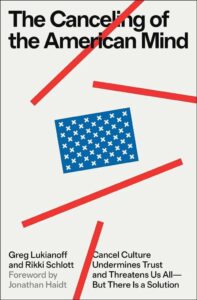
Book review: The Canceling of the American Mind

Cancel culture is a prominent, ugly feature of public discourse today, yet many claim it doesn’t exist. They say there are only “consequences,” which amounts to saying that if you’re subjected to abuse because you said something controversial, what else did you expect?

Gangs of goons shout speakers down and claim that doing so is part of the right of “free speech.” By their logic, DDoS attacks on websites and jamming of radio communications are free speech. They shout “Shame! Shame!” as if anyone besides themselves were acting shamefully. They have only one standard: their authority to command others and demand silence from anyone who doesn’t think as they do.

It wasn’t always this way. Threats and demands for punishment of heretics have always been around, and some periods in American history have been full of open violence against opposing views, but the present levels of hostility are the worst in decades. In The Cnceling of the American Mind, Greg Lukanioff and Rikki Schlott document how frequently people on both the right and the left have come to regard anyone who disagrees as an inherently evil person, an enemy to be brought down.
(more…)