education


Plagiarism accusations against Harvard’s president

Taking a principled approach means that sometimes you support a person in one respect while being severely critical in another. I supported Harvard president Claudine Gay when she said that calls for genocide don’t categorically qualify as harassment. But now there’s evidence that she’s a repeat plagiarist, and that demands strong criticism if she is.

Update: Claudine Gay has resigned as president of Harvard University. See also the new paragraph at the end of this post.

Plagiarism consists of using someone else’s words or ideas and passing them off as original work. If you cite the source, it isn’t plagiarism (though it might be a copyright violation if you use too much). Sometimes it’s tricky to identify. Two people can have the same idea independently. Words can stick in your mind, leading you to use them without being aware that you’re lifting them from another author. Sometimes there’s just one good way to say something.
(more…)

Cancel culture goes mainstream

“One down. Two to go. This forced resignation of the president of @Penn is the bare minimum of what is required.”

That’s the kind of language you might expect from the Minister of Truth in a socialist dictatorship. It’s from Elise Stefanik, a Congresswoman from New York. The offense for which Stefanik and many others are seeking to remove three university presidents is the failure to regard advocacy of genocide unconditionally as harassment.
(more…)


To kill a student’s mind

A teacher who wants to limit students’ minds and close off their horizons is a vile person. To Kill a Mockingbird is a powerful, moving novel about racial injustice in the South. It presents a world that’s different from today’s America and presents the suffering and hope of the people who suffered and tried to correct its injustices. A man defends the target of a false criminal accusation at great personal cost. For this reason, four progressive teachers in the state of Washington wanted to keep their students from reading it. A Washington Post article tells the tale.

In their formal challenge to the book in the Mukilteo School District, the teachers claimed, “To Kill A Mockingbird centers on whiteness. … It presents a barrier to understanding and celebrating an authentic Black point of view in Civil Rights era literature and should be removed.” Three of the four are white, just by the way. Claiming that the novel “centers on whiteness” shows either gross ignorance of the book or gross dishonesty. In normal use, the Civil Rights Era began in the 1950s, and the novel is set during the Depression. It’s true that it doesn’t celebrate what it was like to be black in Alabama in those days.
(more…)


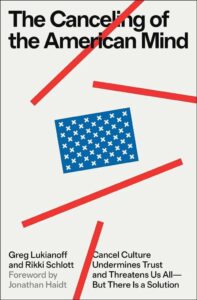
Book review: The Canceling of the American Mind

Cancel culture is a prominent, ugly feature of public discourse today, yet many claim it doesn’t exist. They say there are only “consequences,” which amounts to saying that if you’re subjected to abuse because you said something controversial, what else did you expect?

Gangs of goons shout speakers down and claim that doing so is part of the right of “free speech.” By their logic, DDoS attacks on websites and jamming of radio communications are free speech. They shout “Shame! Shame!” as if anyone besides themselves were acting shamefully. They have only one standard: their authority to command others and demand silence from anyone who doesn’t think as they do.

It wasn’t always this way. Threats and demands for punishment of heretics have always been around, and some periods in American history have been full of open violence against opposing views, but the present levels of hostility are the worst in decades. In The Cnceling of the American Mind, Greg Lukanioff and Rikki Schlott document how frequently people on both the right and the left have come to regard anyone who disagrees as an inherently evil person, an enemy to be brought down.
(more…)


(Un)banning the Bible in Utah

The Davis school district in Utah has reversed an earlier decision removing the Bible from middle and elementary schools. Few people thought it should be banned; the challenge to it was supposed to be a reductio ad absurdum of the policies that led to the removal of other books. Unfortunately, the appeal committee and the district officials missed the point. They said that “the Bible has significant, serious value for minors which outweighs the violent or vulgar content it contains.” Of course it does. The point is, so do many other books. Violence and vulgarity, even outright immorality, aren’t a sufficient reason to exclude books from school libraries.

The Bible is a horrible book. The Old Testament presents a sadistic, murderous God who drowns nearly the entire world population, firebombs cities, orders the extermination of every man, woman, and child in other cities, and decrees death penalties for many kinds of actions. In the New Testament, this sadist comes to us, not to beg for forgiveness for his crimes, but to say that he’ll forgive us, on the condition that we believe he turned himself into a human in order to be executed. People who don’t believe that claim will be tortured forever.
(more…)