Book discussion


Book discussion: Fighting for the Freedom to Learn   Recently updated !

The history of what’s known as “school choice” is more convoluted than I had realized. Fighting for the Freedom to Learn, from the Cato Institute, maps out that history in a set of twelve essays by different authors. Together, they add up to a narrative from the colonial era to modern times in the United States. The book is less polemic than its title may sound, providing a lot of information for anyone interested in the history of American education.

This isn’t an area where I have much knowledge, so I can’t say confidently how accurate it is. I can say that it presents an informational tone, has lots of end notes, and doesn’t say anything that looks obviously suspicious.

Most people today look at advocacy of school choice as an exclusively right-wing issue. (Everything today is a right-wing or left-wing issue.) In the past, though, it’s been complicated. Today we think of public schools as secular institutions, but for much of our history they were tools of nativist Protestant hegemony. I’m old enough to remember being told in school to pray to “Our Father.” In the first half of the nineteenth century,

A crucial factor of the development of the state role in education was an expansion of the concept of the citizen. With increased discussion of alternative forms of political authority, there was a renewed appreciation of Aristotle’s argument that citizens should be shaped by state-directed education to match the form of government under which they would live.

The concern increased along with the growth in Irish immigration, which was mostly Catholic. Senator James Blaine promoted state constitutional amendments, as well as unsuccessfully urging a national one, barring the granting of government funds to religious schools, while insisting that they could “not be construed to prohibit the reading of the Bible in any school or Institution.” By “the Bible,” he meant the King James Bible. The target of the amendments was Catholic schools.

The authors acknowledge that following the Supreme Court’s Brown decision and the Civil Rights Act, many segregationists saw private schools as a way to maintain racial purity, but they insist this is far from the whole story. Public schools with predominantly black student bodies often got a bad deal (and sometimes still do).

Throughout American history, people from all walks of life have sought educational options for a variety of pressing reasons, most of them rooted in freedom. The roots on the left are deep and fascinating. They are found in the centuries-old struggle for educational opportunity in the black experience, in the liberal academics who saw vouchers as a tool in the War on Poverty, in the counterculture dissidents who sparked the “free schools” and homeschooling movements, and even, for 20 years, in the Democratic Party’s national platform.

There’s a lot to learn from this book. I recommend it to people interested in American educational history.


Book discussion: You Don’t Own Me   Recently updated !

I’ve been neglecting book discussion posts. Starting with this one, I want to make them a more regular feature of this blog, at least one a month. Books are important, and doing this will not only help me to get the word out about them, it will push me to read more.

(I thought I’d published this a month ago, but I can’t find it in my blog. Here it is now. My next book discussion should follow very soon.)

Individualism isn’t just a political concept. It’s an outlook on life, the recognition that each person is distinct and important. An outlook that values the individual affects our personal interactions. The arts can affirm this outlook or reject it. Timothy Sandefur’s You Don’t Own Me addresses the intersection of the arts and individualism, with mixed results.

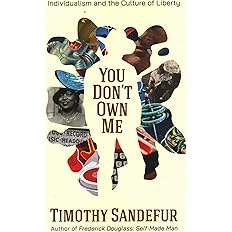
Cover of You Don't Own Me by Timothy SandefurThe cover art looks like jigsaw pieces that don’t obviously fit together, which could also describe the book. It’s a series of loosely connected essays. The second one is the text of a speech, which with a little editing would have fitted better into the book. Some of the sections are quite good. “Zora Neale Hurston, Undefeated” makes me want to learn more about that author. On the other hand, “Anarchy, State, and Zombie Dystopia,” a discussion of The Walking Dead, left me confused because he assumes the reader is already familiar with it. Someone not as obsessively familiar as me with Star Trek might say the same of “Navigating by Fixed Stars: The Moral Trajectory of Star Trek.”
Fragmented as it is, the book will still introduce readers to authors and musicians who have upheld individualist values. It may also give them new information about familiar creators. For instance, I hadn’t known that the time from William Sydney Porter’s first published story as “O. Henry” to his death was barely more than a decade. In at least one case I wish he’d given more information; he credits the song “You Don’t Own Me” to singer Lesley Gore but says only that “two men” wrote it. Songwriters should get credit, but too often only the people who sing their songs get it. That’s especially unfair when the lyrics are the important point, as they are in the title essay.

The book isn’t bad, but it’s hard for me to give it a strong recommendation. Sandefur’s Frederick Douglass: Self-Made Man is more interesting, and I’d suggest reading it first. If you like his writing, you may want to come back to this one.


The Flying Classroom

Every December I reread Erich Kästner’s Das fliegende Klassenzimmer (The Flying Classroom). It’s a Christmas novel set in a boarding school (an Internat in German). It has some of the elements that later showed up in Harry Potter: feuding groups of students, strong friendships, wise faculty members and some who are less wise, and efforts by students to overcome their limitations. Boarding school stories have been popular for a long time.
(more…)


Book review: The Canceling of the American Mind

Cancel culture is a prominent, ugly feature of public discourse today, yet many claim it doesn’t exist. They say there are only “consequences,” which amounts to saying that if you’re subjected to abuse because you said something controversial, what else did you expect?

Gangs of goons shout speakers down and claim that doing so is part of the right of “free speech.” By their logic, DDoS attacks on websites and jamming of radio communications are free speech. They shout “Shame! Shame!” as if anyone besides themselves were acting shamefully. They have only one standard: their authority to command others and demand silence from anyone who doesn’t think as they do.

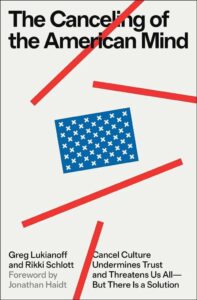
It wasn’t always this way. Threats and demands for punishment of heretics have always been around, and some periods in American history have been full of open violence against opposing views, but the present levels of hostility are the worst in decades. In The Cnceling of the American Mind, Greg Lukanioff and Rikki Schlott document how frequently people on both the right and the left have come to regard anyone who disagrees as an inherently evil person, an enemy to be brought down.
(more…)


Book Discussion: Waco by Jeff Guinn

It’s been thirty years since the disastrous events near Waco, Texas. In the nineties I read and reviewed five books related to them; I’ll link to them at the end of this review. Jeff Guinn’s Waco: David Koresh, the Branch Davidians, and a Legacy of Rage is a new addition to the literature.

The first third of the book, except for a short introductory chapter, is about the history of the Branch Davidians before the ATF raid. Much of what it covers predates Vernon Wayne Howell’s taking leadership and assuming the name David Koresh. This is an important area for anyone studying the matter in detail, but I was more interested in information about the ATF raid, the subsequent siege, and the final assault on the buildings. Getting through the material about the Adventists and the earlier leaders of the group was an effort for me.
(more…)