The World War I years were the worst in the United States’ history for freedom of speech. Eugene Debs was sentenced to ten years for opposing US participation in the war. Charles T. Schenck got the same for distributing petitions against the military draft, and censorship advocates today applaud Judge Holmes’ equation of his advocacy with “falsely shouting fire in a theatre.” There was also a movie that got its creator a federal prison sentence. What did this film do? It celebrated the American Revolution. That made it anti-British, at a time when Britain was our ally in the war.
 If that sounds insane, it is. Under the presidency of Woodrow Wilson, the federal and local governments stomped on freedom of expression as never before or since, and the Supreme Court said it was fine. Still, The Spirit of ’76 is a weird case. The film was released on May 28, 1917, the month after the USA entered the war. Chicago censors made him cut some scenes depicting British atrocities. It opened in November in Los Angeles; I don’t know if it was seen anywhere during the intervening time. The Los Angeles showing included the censored scenes.
The film was closed after two showings. Goldstein was charged with violating the Espionage Act, a law which imposed broad restrictions on free expression. It’s still on the books, though many parts of it have been removed. At the time, movies were not granted First Amendment protection, maybe because there’s no “speech” in silent films. Given some of the other prosecutions, it might not have helped. Goldstein got ten years in prison and was fined $5,000. He was released in 1921. He was unable to revive his film career. In 1927, he wrote to the Motion Picture Academy:
I am merely a lone man suffering a great wrong for no reason whatever, can you refuse to help me obtain justice? I have never done the slightest thing to warrant this persecution and prejudice against me, which denies the very right to exist. What, in the name of common sense, can be the reason for such wanton injustice?
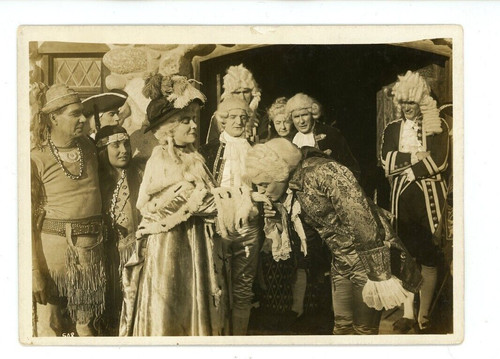 All copies were lost or destroyed, so we can’t see and evaluate the film today. Some posters and still images survive. There’s a synopsis of the film here. I don’t know its sources, so I can’t say if it’s accurate. It says the movie is largely about a fictional marriage of George III before he became king and the bride’s later revenge. Ben Franklin whacks the king. The movie must have played very freely with history. The “atrocities” that were the subject of controversy may have been pure fiction. One scene is supposed to have shown a British soldier sticking a bayonet into a child’s crib. But if inaccurate depiction of history were a crime, hundreds of movies would have been guilty of it. The 1915 Birth of the Nation contained lots of vicious nonsense about the Civil War and its aftermath, and Wilson praised it.
Goldstein had two disadvantages: He was the son of a German immigrant, and he was Jewish. Anything connected with Germany fared badly during the war. The teaching of the language disappeared from nearly all schools. Speaking German was enough to get people accused of spying. The German pharma company Bayer lost its US trademark for “Aspirin,” though it’s still trademarked in many countries. A descendant of the Pilgrims might not have faced the same persecution Goldstein did.
In researching this article, I’ve found disagreement on many points, including what scenes were cut in the Los Angeles showing, when Goldstein was released from prison, and when and where he died. I haven’t dug deep into the sources, so I could be mistaken on some points. However, the broad outline of the story is clear.