history


Book discussion: The Open Society and Its Enemies (1: Plato) 1

A lot of people have never read Karl Popper’s The Open Society and Its Enemies, yet they energetically cite one ambiguous note from it about the “paradox of tolerance” to enlist him as an advocate of censorship. I’m not going to waste more words on those idiots, but rather will comment on the substance of what he wrote.

It’s fashionable to say that what “dead white people” wrote doesn’t matter, but the philosophy of past centuries has shaped where we are today. The effects of European philosophy aren’t limited to white people.

The Open Society and Its Enemies is a two-volume work. The first, which I’ll cover here, is about Plato. The second is subtitled “Hegel and Marx.” While no one follows Plato’s ideas in their original form, his vision of an authoritarian, collectivist state is still highly influential. Some look to his Republic (which is anything but a republic in the modern sense) as an ideal of social stability. The idea of the “philosopher-king” still sounds noble to some. The idea that “justice” means whatever serves the state keeps coming back. The battle for freedom is still largely a battle against Plato. Brave New World, which I wrote about a few weeks ago, is an updated, technologically advanced version of the Republic.
(more…)

Book Discussion: Martin Luther: Renegade and Prophet

When I started my research on The Magic Battery, I needed to find out about the Reformation in Germany. I’d picked that period because it was a time of change and technological advancement, a good background to set changes in magic against. Learning about Martin Luther was important, since I wanted to understand the ongoing conflict of ideas. At the same time, I wanted to learn about daily life in that period. It’s easy enough to get information on the emperors and electors, the wars and alliances, the states and borders. Finding out how people traveled, ate, and married took more work.

Lyndal Roper’s Martin Luther: Renegade and Prophet turned out to be very useful for both purposes. It tells the story of Luther’s life while including lots of details about how he lived. It gives a lot of insight into how people thought in those days.
(more…)


The Faust legend 2   Recently updated !

In The Magic Battery, I play off the legend of Faust. There are many well-known versions of the story, including Marlowe’s play, Goethe’s play, and Gounod’s opera. Liszt was fascinated with the story and wrote a Faust Symphony as well as the Mephisto Waltzes. My treatment is a free one, but it starts from what’s known of the historical Faust. Or should I should say historical Fausts?

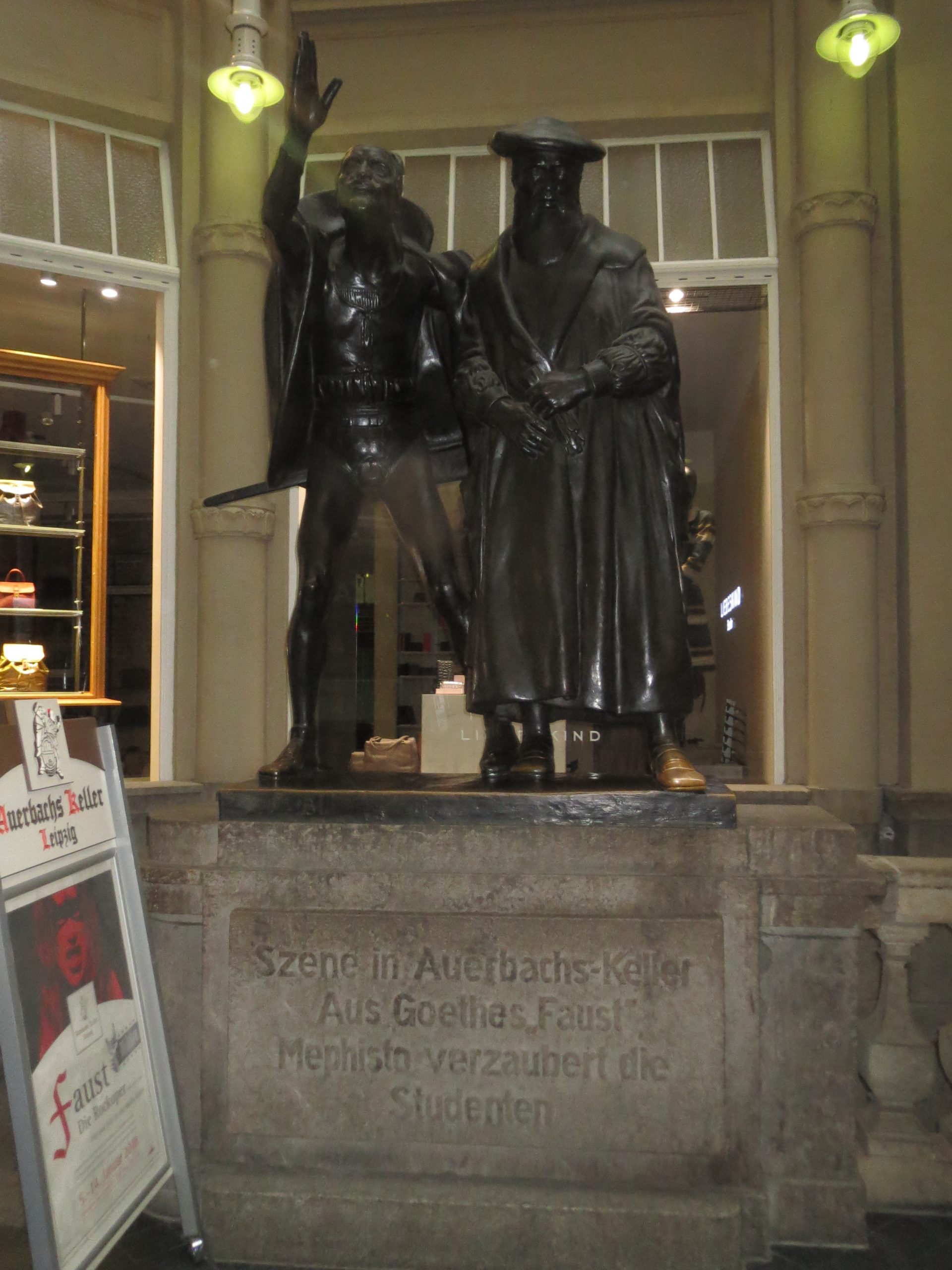
Sculpture in Auerbachs Keller

Sculpture above Auerbach’s Cellar in Leipzig, depicting a scene from Faust

Johann Faust was born in 1466, or maybe 1480. His name is sometimes given as Georg or Johann Georg. Several towns claim to be his birthplace. Could there have been two Fausts, both with a reputation for magic and born over a decade apart? This might explain the part of the story where he becomes young again.
(more…)


The Magic Battery and Martin Luther

One of my first decisions in planning The Magic Battery was to set it in 16th-century Germany. Germany, because that’s the part of Europe I know best. The 16th century, because it was a period of dramatic changes. Copernicus had set out a new view of the universe. Paracelsus had challenged long-held ideas in medicine. Luther had taken on the Catholic Church and divided Christendom.

Luther never appears “on stage” in my novel, but he is frequently mentioned and quoted. Many of the quotes that I use are real; the ones on magic are made up, but I tried to make them true to his character. The main source in my research was Lyndal Roper’s Martin Luther: Renegade and Prophet. The book was also an excellent source on life in that period.
(more…)