Saturday was an excellent first day of spring. I went to listen to the Boston Bach Birthday celebration at the First Lutheran Church. They had all-day performances, mostly on the organ, and a German lunch with bratwurst and sauerkraut. The lunch was a rare opportunity; there are no German restaurants in the area. The music included two recently discovered chaconnes by Bach, maybe their first public performance in Boston. It also included group singing of some old hymns, including one from Luther’s German Mass, which is 500 years old this year. They got this atheist singing hymns in a Lutheran church. 😇
It was sunny and about 50 degrees outside. After lunch I walked through the Public Garden and Boston Common. Near Park Street Station I saw a small group protesting the US oil blockade of Cuba. A guy (let’s call him Mr. Shouter) started yelling at them. I and another man I don’t know (Mr. Talker) went over to talk to him; my aim was just to distract him from a potentially nasty confrontation. In the few minutes we were there, I got some impressions of how that kind of mind works.
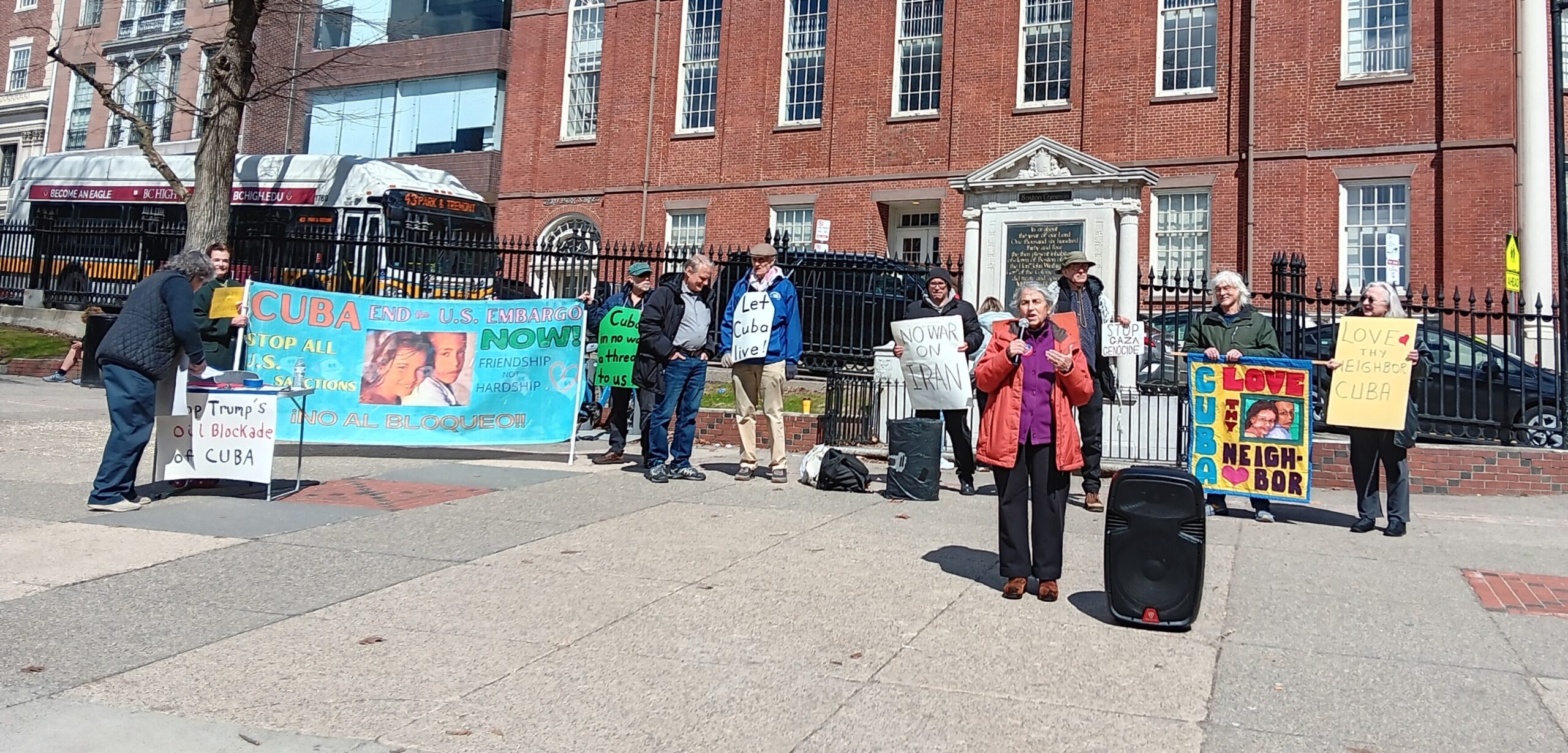 Mr. Shouter was yelling that Cuba has a Communist government. True enough. He also yelled that dissent was impossible in Cuba because anyone who criticized the government would be shot and sent to a concentration camp. It wasn’t clear in which order. Granted, dissent in Cuba is dangerous, even if he exaggerated. I tried to tell him that a large part of that was true, but the best way to weaken Cuba’s rulers was open trade. Cuba hasn’t been a threat to the US at least since the Soviet Union collapsed. He didn’t reply to me or give me much notice; he was more interested in what Mr. Talker said. Talker told him that he had visited Cuba and that it was impossible to stop Cubans from speaking out. Shouter called him a Communist and a liar. Talker didn’t lose his temper. After a little while, I said quietly to Shouter, “If you’d stop yelling long enough to hear what others say, you might learn something,” and went down into the subway station.
We’ve all seen people like Shouter, who always yell and never listen. They’re a cliché of TV and movies, often drawing the protagonist into an unwanted fight. It isn’t other people they’re trying to keep from hearing disagreement. It’s themselves. They’re convinced the world is a certain way, but they know their certainty is built on shaky ground. If they stopped screaming, they might have to think about what they heard. He wasn’t entirely wrong. Cuba lacks freedom of speech, and maybe Talker thought they have more than they do. But Shouter saw its government as incredibly efficient in finding and stamping out every dissenting voice, like Orwell’s Big Brother. He was desperate to banish any possibility that open dissent exists in Cuba. Havana has seen several protests recently, at considerable risk to the participants, but he needs to believe that doesn’t happen.
Weird as it is, some people get satisfaction from believing their foes are all-powerful. Maybe it’s that the greater the enemy is, the greater the victory will be. It’s a literally apocalyptic way of thinking, straight out of the Book of Revelation.
Hopefully Talker and I helped to avoid a nasty scene. I didn’t see anything about the Cuba protesters in the news, which likely means nothing newsworthy happened.
Travel advisory
A special note for today: Trump is deploying ICE to airports. If you have a scheduled flight that isn’t strictly necessary, seriously consider cancelling. Somalis will be targeted; if you have any connection to Somalia, cancel the flight unless it’s a matter of life or death. If you must fly, don’t make an idiot of yourself. Find a way to get where you’re going without exposing yourself to more risk than necessary.
Hi Gary,
I agree. Listening is a valuable exercise. Learning from others is useful.
But I disagree that open trade is guaranteed to produce meaningful trade in all cases. North Korea, Cuba, China, and Russia are leading examples of places that are fundamentally unwilling to moderate. Open trade with China has done nothing to curb their abuses. Quite to opposite, IMO. Contrast that with places like Saudi Arabia where an open trading relationship is fostering change – albeit at a slower than desired pace.
Trade is the carrot. Embargoes (and other tactics) are the stick. If they want the carrot, then they have to demonstrate the capacity to moderate away from dictatorship.
From your description, Shouter was a bit off on the details, but directionally he seems right.
Regards,
Dann
I suppose if you misspell “sorcerer”, it’s a sorcerror? – LK Lohan
I’ll agree with you in the cases of Russia and North Korea. Russia is engaged in a major war of conquest, and North Korea has no significant private activity that would let people bypass the government, as well as always being on the edge of launching a war. I think Cuba offers more hope that trade would weaken the dictatorship. But my main interest in this point is in the style of thinking (or rather, avoiding thinking). If Shouter had actually shown interest in making a case, it could have been an interesting discussion.
Hi Gary,
Based on your description, I agree that Shouter could have been more effective if he was less Shouter and more Talker.
In the past I have been more supportive of the theory that free trade harms dictatorships. Experience suggests to me that there are other qualifications to be met before free trade can meet that objective.
Regards,
Dann
“Much of what is called ‘social problems’ consists of the fact that intellectuals have theories that do not fit the real world. From this, they conclude that it is the real world which is wrong and needs changing.” — Thomas Sowell