Yesterday’s Songs Transformed: Update 1

Yesterday’s Songs Transformed is getting close to completion. I’m working on the introduction, which traditionally is one of the last things you write. It deals with the relationship of the book to Tomorrow’s Songs Today. TST is about filk music. YST grows out of my interest in filk. It puts the rewriting of song lyrics into a bigger context. I expect a large part of my audience to be people interested in filk, people who love the idea of replacing old lyrics with new ones. I also hope that other music lovers will get enjoyment out of it.
(more…)

Maximizing the value of each word

When I’m polishing text that I’ve written, I find myself thinking about the value each word contributes. Can I replace a long phrase with a short one with equal value? Can I use a high-value word in place of one that has relatively little?

By “value” I mean the precision and impact which each word contributes to the statement. A precise word has more value than one with a broad meaning. A straightforward word or phrase has more value than a cliché. A sentence with a high value per word has more impact than one that’s full of low-value words.
(more…)


Working with Finale and Open Office

A current project of mine is compiling and editing the songbook portion of the ConCertino 2018 program book. I’m using OpenOffice for the pages and Finale for the music notation.

This is the first time I’ve worked with the full version of Finale on a project. Previously I’d used the budget versions, called Finale Allegro and later Finale PrintMusic. When the publisher dropped PrintMusic and offered a cheap upgrade to Finale, I took them up on it. I didn’t think that the extra features would be that useful for my purposes, but they’ve turned out to be quite helpful.
(more…)


The right word 4

Of all the crimes against good writing, the worst is using the wrong word. A grammatical error looks sloppy, but as long as it doesn’t change the meaning of the sentence, people will get what you mean. Use the wrong word, though, and you fail to convey what you’re trying to say. That amounts to failing as a writer.

Usage errors fall into several categories. This isn’t an exhaustive list, but it includes the types of errors that annoy me the most.
(more…)


W. A. Mozart, ghostwriter

A stranger approached Wolfgang Amadeus Mozart in July 1791. He wanted Mozart to write a Requiem for a patron and to finish it as quickly as possible. Mozart never finished it. On December 5, he died. Some people think he was poisoned.

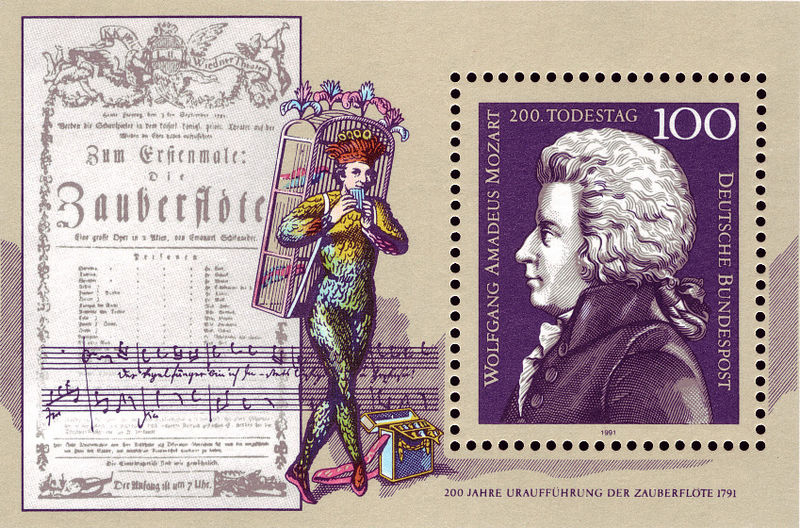
The patron was named Count Franz von Walsegg. The Count wanted to pass off Mozart’s work as his own, in memory of his recently deceased wife. In other words, he hired one of the greatest composers in history as a ghostwriter of music. Mozart’s students, Franz Xaver Süssmayr and Joseph Eybler, finished the work. Walsegg made a partial payment to Mozart; it isn’t clear whether he paid for the completion. The condition of secrecy had been thoroughly ruined by that point. German Mozart postal commemorative
(more…)


The Cadaver King and the Country Dentist

Cover of The Cadaver King and the Country Dentist This is a blog about writing, and books are writing, so book reviews are on topic here, right? The book in question here is The Cadaver King and the Country Dentist, by Radley Balko and Tucker Carrington. It’s an important book and one that may shock you. If I had more vivid powers of visualization, I might not have been able to get through it.

Before reading this book, I had plenty of reasons to believe the American criminal justice system is broken. Now I have more. The book focuses on Mississippi, which has a long record of being one of the worst states in that respect, especially if the accused is black. It focuses on two individuals, Doctors Steven Hayne and Michael West. Both helped to convict many people with what was believed to be their forensic expertise. Both have been pushed out of that role by the light shed on their work. Radley Balko has played a big role in accomplishing that. But the bigger issue is a legal system that allowed junk science to be used as evidence.
(more…)


HTML for blog writers

If you write for websites, you need to know the basics of HTML. Even if you do your writing in Microsoft Word, Open Office, or a Web editor, it will get turned into HTML (or, less often, PDF). You need to understand how it will work in its final form.

HTML is a markup language. It’s text which contains plain human language plus tags that tell the browser how to render it. The tags are more guidelines than rules. They indicate an intent rather than dictating an exact appearance. In different browsers, or even different settings in the same browser, you might see differences in fonts, spacing, colors, and so on.
(more…)


Being an honest ghostwriter

It is an honest ghost, that let me tell you.
(Hamlet, Act I, Scene 5)

When you aren’t writing under your own name, the boundaries of honesty aren’t quite the same. You aren’t being hired to say what you believe, but to put someone else’s ideas into words. It isn’t dishonest as such to say things which you don’t personally believe are true, but you don’t have a license to lie. Where’s the boundary you can’t cross without becoming dishonest?

Advocacy vs. deception

The slope is slippery, so I stay well back from the brink. I’m willing to present a case for a conclusion which isn’t clearly false, even if I have doubts about it. For instance, I see no ethical problem with writing an article that says cloud-based VoIP is best on one day, then an article the next day saying an on-premises IP PBX is better. Both are true under some circumstances. However, I won’t write an article claiming an IP PBX is illegal — at least, not until I learn that some government has actually outlawed it.
(more…)